Skip to content

Results of the 2018 Ho’ala Swim

HoalaSwimThe Ho’ala swim is held exactly one week before the Kona race on the swim course. There are slight changes towards the end, the finish is on the small beach at the King Kam hotel instead of back on “Dig Me Beach”, usually resulting in slightly quicker times compared to the Kona swim. It is used by a lot of athletes as an excellent open-water training session, the table below shows just the Kona Pros that I have been able to identify in the results, comparing their times in this year’s swim, their expected swim times for this year’s Ironman race (plus the difference, usually faster) and the same results (as long as they are available) for last year’s Ho’ala swim and Ironman Hawaii swim.

Some observations:

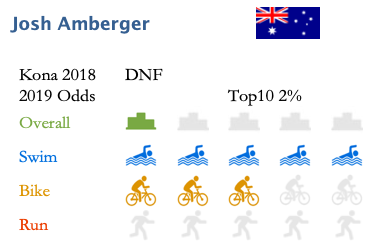
  • From the reports I have heard, Josh and Lucy swam hard in the second half and created a sizable gap to the rest of the field. A few athletes (Braden Currie, Matt Chrabot and Reece Barclay who raced in the M25 agegroup)  followed for some time but ended up more than 30 seconds behind. Tim O’Donnell led the rest of the field but was already more than two minutes behind.
  • Lucy’s time would have been well under the Kona swim course record (48:43 by Jodie Jackson from 1999).
  • Most athletes swam about 1:30 quicker than their expected swim times. However, there were reports that most athletes started 50 meters in front of the start buoy when they were pushed out by the swell. Nonetheless, Katja Konschak and Beth McKenzie swam six minutes faster than their expected swim times! Only Patrick Lange swam slower than his expected Kona swim time.
  • There are a number of interesting speculations one could start from these swim times, for example both Cam Wurf and Lionel Sanders swam well faster than their expected swim times. But they probably only have limited value as it’s hard to tell how comparable the effort in the test swim is to the race.
Athlete Ho’ola Swim Expected Swim Faster By 2017 Ho’ola 2017 Swim
Josh Amberger 00:47:08 00:48:51 1:43 00:47:09
Lucy Charles 00:47:09 00:50:41 3:32 00:48:48 00:48:48
Braden Currie 00:47:41 00:49:54 2:13 00:48:41
Matt Chrabot 00:47:48 00:51:21 3:33
Timothy O’Donnell 00:49:41 00:49:59 0:18 00:48:38
Teresa Adam 00:50:25 00:53:45 3:20
Tim Don 00:50:30 00:50:30 0:00 00:48:55
Antony Costes 00:50:31 00:52:08 1:37
Patrick Lange 00:50:34 00:50:03 -0:31 00:48:45
Will Clarke 00:50:37 00:51:45 1:08
Thiago Vinhal 00:50:39 00:52:07 1:28 00:49:47 00:49:00
Luke McKenzie 00:50:41 00:51:43 1:02
Katja Konschak 00:50:43 00:56:43 6:00
Mike Phillips 00:50:45 00:52:14 1:29
Cameron Wurf 00:50:58 00:54:35 3:37 00:53:49
Alessandro Degasperi 00:51:01 00:53:40 2:39 00:53:44
Lionel Sanders 00:51:22 00:55:52 4:30 00:52:37 00:53:41
Rachel McBride 00:52:54 00:56:35 3:41
Jocelyn McCauley 00:53:37 00:57:44 4:07 00:55:41 00:54:31
Nick Baldwin 00:55:15 00:56:45 1:30
Kaisa Sali 00:55:47 00:59:44 3:57 00:56:04 00:57:53
Lisa Huetthaler 00:56:56 00:59:58 3:02
Linsey Corbin 00:57:02 01:01:25 4:23 00:59:55 01:00:07
Beth McKenzie 00:58:30 01:04:31 6:01
Mareen Hufe 00:58:47 01:02:05 3:18 00:58:28 00:59:04
Angela Naeth 00:58:53 01:03:07 4:14
Mirinda Carfrae 00:59:03 01:00:23 1:20
Gurutze Frades Larralde 01:03:02 01:04:53 1:51 01:04:58

Kona Kings & Queens: Cameron Wurf

This is an excerpt from my “Kona 2018 Rating Report“. You can download your copy here.

Wurf BIbWurf Points

Cam has been touted as “Ironman’s Top Cyclist” by Triathlete Magazine – and like Andrew Starykowicz he has been setting bike course records left and right, including a 4:12 in Kona last year. Still he was a bit disappointed with his Kona 2017 race, calling it his “life time best bike” but also “life time worst swim and run”.

Cam has been racing a lot this year: He finished six IM-distance races. Even without showing all his cards the progress on the run has been evident, in his last two races he posted his first sub-3 runs (2:58 in Switzerland and 2:52 in Almere). He will also be racing Kona with a few more improvements in his bike setup: He was racing a Pinarello prototype in Almere and afterwards went to the wind tunnel for some fine-tuning.

It’s likely that Cam’s plan for Kona 2018 starts with a faster swim than last year – last year he first had to play catch-up to join Sebi and Lionel for the chase to the front. Once Cam and the rest of the group hit the lead, a lot of athletes will be forced to drop back even without Cam putting in a surge. He will be interested in a good position at the start of the run, but more so in having a great marathon as well. Even Cam is unsure of what he’s able to do as all his marathons this year have been controlled, steady efforts without going all out in the last kilometers. Last year, a 3-hour marathon would have seen Cam in fifth place – what will he be able to do this year?

Wurf Bike Challenge Almere

Photo: Cameron racing the bike leg at Challenge Almere with a new Pinarello tri bike. Credit: James Mitchell

Kona Kings & Queens: Mirinda Carfrae

This is an excerpt from my “Kona 2018 Rating Report“. You can download your copy here.

Rinny Points

Rinny Bib

After her baby break last year, Rinny is back in Kona, looking for another title or at least a podium. She validated her Kona slot with a sub-9 hour second place at IM Cairns and focused on racing 70.3s over the summer, a typical Kona build for her. Even though a lot of young fast women are now racing in Kona, Rinny wants to show them that she is still competitive, and she and coach Siri Lindley will have worked hard to be able to challenge Daniela for the win in Kona. Based on her previous results she’s expected to start the run around 20th place, about ten minutes behind the podium spots. And even though she’s still my pick for the fastest run split, there are now a lot of athletes that aren’t much slower than her.

To be in a better T2 position the second half of the bike is crucial for her – that is where she has been losing most of the time to the others. Instead of riding on her own as she often had to in previous years, she could benefit from being pushed by other women around her, allowing her to minimize the time she’s behind in T2. If she can then unleash another marathon like her course record 2:50 from 2014, the last hour of the female race could develop into be a battle you shouldn’t miss.

Rinny Run

Photo: Rinny running in the Energy Lab on the way to second place in Kona 2016. Credit: Jay Prasuhn

Kona Kings & Queens: Sarah True

This is an excerpt from my “Kona 2018 Rating Report“. You can download your copy here.

SarahTrue Points

SarahTrue Bib

Thorsten: Why have you decided to tackle Kona after working so hard for an Olympic medal?

Sarah: After a rough Rio experience, both in terms of build-up and race, it took me a while to bounce back. I realized that I was too heartbroken to continue with ITU. After a few 70.3 races last summer, I realized that I enjoyed the non-draft racing, too. Last October, the desire to race at Kona hit me strongly. I love this sport and such a huge part of it centers around the IM World Champs. I felt like my career would never be complete without racing at triathlon’s biggest race.

T: You’re being coached by Dan Lorang who also works with Jan Frodeno. How did you end up with a German coach?

S: Dan and I started working together in December. I’ve respected Dan for years and it occurred to me that it would be important to have someone who understands the ITU background well in my transition to long-course. He has experience in coaching ITU and IM and has successfully transitioned athletes between the two. He’s also a really good person of high integrity and that’s of utmost importance to me.

T: How much has your training changed since switching your focus?

S: I was actually surprised by Dan’s approach; we’ve done more intensity and less volume than I expected. I was very nervous going into my first IM since we hadn’t done any long, hard rides or runs, but I trusted his experience. 
The biggest change that I’ve really liked is that I do little training on easy days. As an ITU athlete, my easy days would still be multiple workouts and I feel as though that impacted my ability to do hard days well. My big days are bigger with IM training, so my easy days are smaller.

T: What were your expectations going into your first Ironman race in Frankfurt?

S: Before the race, Dan was very straightforward with me: the goal was to qualify with Kona with a Top 7 finish and we didn’t feel as though I had yet done the work to have a great race. We were conservative with the effort and it ended up better than expected.
There’s always a fear of the unknown and I was definitely nervous; my longest run was one 32km run and I had no idea whether I could run a marathon off the bike. The most surprising thing for me was that good nutrition and pacing could make up for being underprepared in training.

T: Please describe the way from Frankfurt to Kona. How did 70.3 Champs fit in? What have you been focusing on, how has the training changed compared to before Frankfurt?

S: When Dan and I talked in December, I stated that my one goal for the season would be Kona and we’ve structured the year accordingly. It’s been a very slow, gradual build and we should have me in peak fitness mid-October, barring any unforeseen hurdles. After Frankfurt, we took a couple of easy weeks and then started to build up to 70.3 Champs. Dan felt as though the timing for 70.3 Champs was ideal. I like Championship racing, so it was worth choosing a bigger, competitive race than a 70.3 with a weaker field. Fast races are great training and preparation for goal races like Kona.

T: What happened to you at 70.3 Worlds? You seemed to be in a great position after the swim …

S: About 30km in, I lost my nutrition and flat kit. 10km later, that proved to be a problem when I got a flat. It’s probably more accurate to say that I had one flat that I couldn’t fix properly; I used Pitstop to fix it but it didn’t hold for long. Fortunately there was mechanical support, but I had to wait for a while. I wouldn’t have been able to continue racing without them, so I’m grateful they were on the course.

T: Have you been to Kona before? What’s the goal for your first Kona?

S: I’ve never been to Kona, so I’m really looking forward to the experience. I will be on the Big Island between 70.3 Worlds and IM World Champs, so I’ll get to know the course and conditions well.
I want to show up to the start line fit and prepared for a great race. I can’t control how others perform, so ultimately it’s about bringing my best to the race and trying to let my preparation shine. It’s such a tough race; so many incredible athletes struggle with adversity there, so I know better than to have any clear outcome goals. That said, it’s very expensive and I have to figure out how to pay for my travel expenses. Finishing in the top-10 would help.

T: Tactically, where do you see yourself “fit” in the Kona field?

S: Honestly, I only have a vague concept of how I’ll fit in the field. We were definitely conservative in Frankfurt, but the conditions of Kona also warrant some caution. With Kona, I’ll be surrounded by 34 other terrific and experienced IM athletes. I’m guessing that I won’t be that lonely! The key will be using others to help me perform to my best without getting too excited and pace harder than I can manage.

T: How surprised were you by your 2:54 in Frankfurt? And what do you think you can run in Kona?

S: Before the Frankfurt, I asked Dan about pace and his answer was funny: “I have no idea. Until you race an Ironman, I can’t give you an estimate”. I used pace to make sure I didn’t go out too hard the first 10km, but I just relied on perceived effort. It didn’t feel that hard, so I’d like to think that I can run faster in similar conditions. Of course, I’ll be biking harder, so that will impact my run. While the temperature for the marathon in Frankfurt was similar to average temps in Kona, the humidity is much higher in Hawaii and that will slow me down. How much? I have no idea!

Sarah True IMFrankfurt

Photo: Sarah on the bike at IM Germany with the Frankfurt skyline in the background. Credit: James Mitchell

Kona Kings & Queens: Andrew Starykowicz

This is an excerpt from my “Kona 2018 Rating Report“. You can download your copy here.

Starky Bib

Starky Points

Starky BikeAndrew’s made a great recovery from a serious accident when he was dragged under a truck and it looked as if he might struggle to walk again. He returned to racing a year ago and hasn’t changed his racing style: Hammer the bike leg and then hold on as much as possible on the run. By winning IM Louisville one day after Kona 2017 he secured a Kona slot and there will be a lot of eyes on his return to Kona.

As a front pack swimmer he is quite likely to take the lead from Josh Amberger early on the bike. He has indicated before the race that he wants to light up the bike course similar to when he rode the first sub-4 IM bike leg in Texas. Andrew has been setting bike course records in his last four Ironman races, and I’m sure that he wants to continue that series in Kona even if race day conditions have a huge impact on the Kona bike times.

With a fast bike leg Andrew might even be able to hold off the uber-bikers who are slower swimmers until T2, but in order to be competitive in Kona, he will also need a great improvement on his run – so far his best marathon is a 2:58 from Florida 2013. But he’ll be aiming for a new PR on the marathon, and a sub-3 marathon would probably see him finish in the Top10. Just like Lionel, Andrew will be fighting hard, so we might see a late explosion – or a spectacular break-through performance.

Photo: Andrew leading the bike in Kona 2013. Credit: Eric Willis

Select your currency
EUR Euro

By continuing to use the site, you agree to the use of cookies. more information

The cookie settings on this website are set to "allow cookies" to give you the best browsing experience possible. If you continue to use this website without changing your cookie settings or you click "Accept" below then you are consenting to this.

Close