Skip to content

Analysis

Looking at smaller races without a dedicated “Pro” category

There are a lot of long-distance races on the schedule that are not quite as big as WTC-branded Ironman or Challenge races. Probably the biggest of these is evens in the Rev3 series which mainly offers 70.3 distances but also has a few long races. I’ll have a closer look at the Rev3 races soon, but for now I want to have focus on some “unaffiliated” races.

In order to figure out what to do with these races, I had a closer look at three races:

  • Norseman: One of the fantastic races that add a great, scenic course to the long distances
  • Vineman: Another “pretty race”, but one that also has a long history – it’s probably the oldest Ironman distance race on the North American continent (i.e. not counting Kona)
  • Ostseeman: An example of the smaller, non-affiliated races (and very dear do me, as this is one of the IM-distance races I have done and just one hour drive from where I live)

While I like these races, analyzing them with a Pro focus (such as I have for trirating.com) is tricky:

  • they don’t have a dedicated “Pro” category (making it hard to identify the Pros, especially new ones or those that have recently changed names)
  • very few Pros compete in these races (I already have some “matching” algorithm to deal with slight spelling differences, but even with that I can’t identify too many Pros)
  • even if I can identify a Pro, older results may be from back when they were still racing age-grouper (and including these result would skew their “Pro” rating)

In short, I have very few good data points for these races, making an analysis very hard and probably not very meaningful. Therefore, I have decided to focus my work on other races and the questions related to these.

Having said this, by pulling together all “Pro” results from all the years I managed to come up with an “unofficial” course rating for Norseman:

Rating Swim Rating Bike Rating Run Rating
-2:07:49 -06:30 -1:00:47 -0:59:27

As this is not a result of my usual calculation procedure, I will not include this in my list of course ratings. Still, these numbers give a good indication how hard the Norseman course is.
Unofficial KPR for Women’s July cutoff

After IM Switzerland, here is an excerpt from my unofficial update to the KPR standings:

Rank Name Points
12 Erica Csomor 6.310
17 Sofie Goos 5.940
27 Rebeccah Hoschke 5.190
28
Sara Gross 5.110
2830 Amy Marsh 5.095
2931 Ashley Clifford 4.985
30 Sara Gross 4.830
31 Rebeccah Hoschke 4.740
32 Charisa Wernick 4.700
33 Britta Martin 4.650
34 Sarah Piampiano 4.530
35 Kathleen Calkins 4.490
36 Stephanie Jones 4.280
37 Rebekah Keat 4.160
38 Liz Blatchford 3.930

Update: Anna Ross noticed an error in the points for Rebeccah Hoschke. (I had one race too much for her. I’ve made the same error for Sara Gross.) Rebccah moves down to #31 and will probably get the last July spot. However, she is just 40 points ahead of Charisa Wernick, so any changes in the Switzerland results could result in more changes in the KPR standings.

Remember that the cutoff line comes at #31: There are 28 qualifiers, plus 2 automatic qualifiers (Rinnie and Leanda), and Kelly Williamson in  #29 who is not interested in racing Kona this year (she also hasn’t validated). This means that I have Ashley Clifford as the last July qualifier.

A word of warning: I may have some errors in my numbers, the results are unofficial etc. As far as I can see, the ongoing races (at the time of this writing) in Lake Placid and Calgary are not going to change things – but I may have missed someone.

Congrats to all those who qualified and “have a great race” to all those that are going for an August slot.

Do Women have to race more often than Men in order to qualify for Kona?

As women will need more KPR points in order to qualify for Kona, the question has been asked if women have to race more often than men for a Kona slot. This post compares men’s and women’s number of Ironman races, KPR points and points per race.

Number of Ironman Races

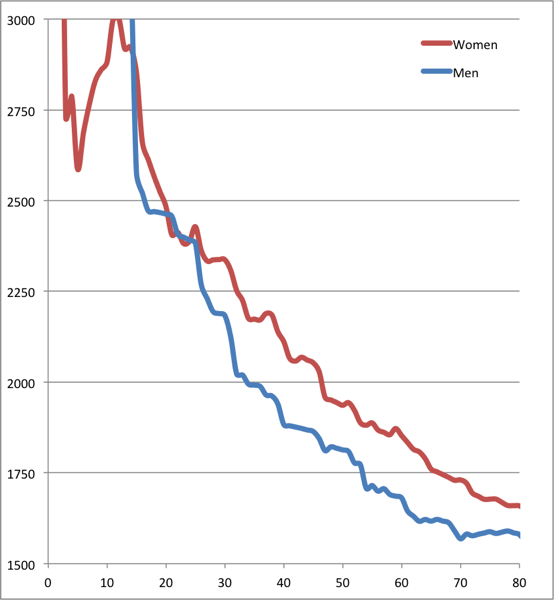
Here’s a graph that shows the number of races for men and women:

MenWomen2013

The red line shows the data for women, the blue line the men’s data. On the x-axis, the graph shows the position in the KPR ranking, the y-axis the average number of IM-distance races that the first x number of athletes have races. (E.g. the data points at 15 show that the men and women between number 1 and 15 in the KPR rankings have raced a similar average number of races, about 2.6 races.)

At first the two graphs diverge a bit. This is caused by a few “outliers” of well-placed women with a large number of races:

  • Gina Crawford: 6 races
  • Meredith Kessler: 4 races

At about the July cutoff place for women (#28) the graphs are closer together, but women have raced slightly more often. The difference is about 0.2 races – pretty small, and probably caused again by a few outliers (Mirjam Weerd: 5 races, Mareen Hufe and Ashley Clifford 4 races).

After that, the graphs are very close together and the differences are only statistical blips. My interpretation of the data: There is no meaningful difference between the men’s and women’s number of races.

Number of KPR Points

The explanation of the different cutoff numbers for men and women is very simple: It is caused by the women’s cutoff occurring at #28, while the men’s cutoff occurs at #40 – obviously you need more points to place 28th than to place 40th.

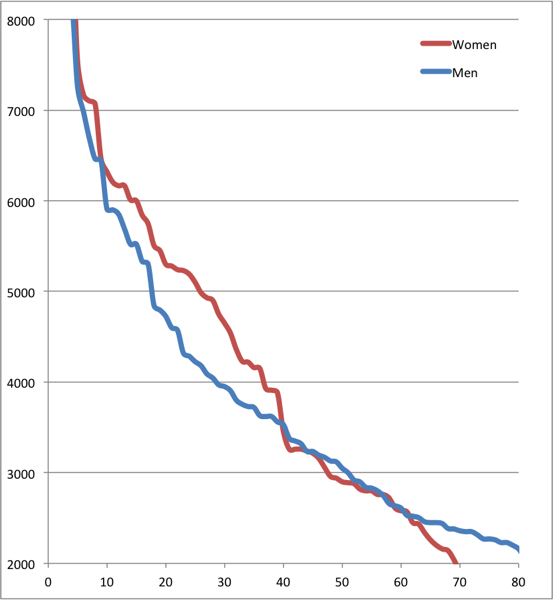
But then the next question comes up: Is there a difference between the number of points required 28th (or 40th) between men and women? Here’s a graph that can help answer that question:

MenWomenPoints2013

Gain, the graph shows the place in the KPR rankings on the x-axis. ON the y-axis, it shows the number of points required to rank that high.

There is a clear separation of the two graphs around the women’s July cutoff of #28, it’s almost 900 points. The graphs narrow again at the #40 spot and stay pretty close together until about #60.

My interpretation: Women placed around #28 have a larger number of points than their male counterparts.

Putting both observations together

From the two graphs shown, we have two observations for the KPR spots around #28:

  • Women and men race about the same number of races for their points.
  • Women have a larger number of points than men.

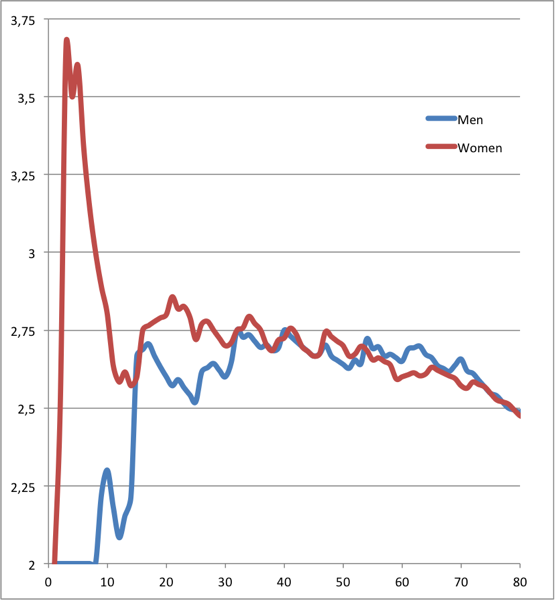
There is only one way I can see that these two observations can both be true: Women must be making more points per race. So here is a third graph:

MenWomenPointsPerRace2013

The graph displays the average number of points per race on the y-axis. After the initial movements in the graph settle down, we can indeed see that women make more points per race: The difference around the #28 spot is about 150 points per race.

I’m assuming that this means that the women’s fields are not quite as deep as the men’s, so it is a bit easier to make more points for the women. However, the difference is quite small – 150 points is about the difference of 2 spots (5th place and 7th place, 6th to 8th etc) in a P-2000 race or 4 spots in a P-1000 race.

KPR situation for end of July 2013 races

The interest into the first round of KPR cutoffs at the end of July is increasing. After having a look at the start lists for the last two races (Lake Placid and Switzerland on July 28th), here is an analysis of what the situation looks like and where I expect the cutoffs to occur.

Men

For the men, there are 40 July qualifiers. At the end of last year, I estimated the July cutoff to occur at 4.000 points.

There will be at least one extra spot with Crowie being an automatic qualifier. (Macca, the other past champion sits in #70 with 2.450. He gets a Kona spot, but doesn’t “move the line”.) It is not 100% clear how the 70.3 champion (Sebastian Kienle) is handled, but I assume that he also does not count against the number of July qualifiers. This means that the cutoff will probably occur at #42 – currently Chris Legh at 3.420 points.

For Lake Placid, these are the athletes close to qualifying:

  • Andy Potts: 5.850 points (but still has to validate)
  • Tim Van Berkel: 3.610 points
  • Ian Mikelson: 3.325 points
  • Andres Castillo: 3.280 points
I’m assuming that each of these athletes should be able to move to at least 3.800 points. (It would require Andres to finish in #5 or higher.)
A few of the athletes on the Switzerland start list should be safe already:
  • Petr Vabrousek: 5.520 points
  • Ronnie Schildknecht: 4.225 points
  • James Cunnama: 3.905 points (I don’t think he’s planning to race in Zurich so soon after Roth, it’s probably just a precaution in case he feels his Kona spot is in danger.)
As Switzerland is a P-2000 race, a few more athletes have a chance to get enough points:
  • Cyril Viennot: 3.380 points
  • Marko Albert: 3.235 points
  • Ben Cotter: 3.170 points
  • Mike Schifferle: 2.840 points
  • Michael Wetzel: 2.530 points
  • Simon Cochrane: 2.505 points
In order for Michael or Simon to move to 3.800 points, it would require a 4th place finish – a tall order. Mike would need a top 8 finish. This means that probably three athletes from Lake Placid and four athletes from Switzerland would move to 3.800 points or move. This would move the cutoff to the athlete currently ranked #35 – Marino Vanhoenacker with 3.720 points.
There are 10 more spots at the end of August. At the start of the year I estimated the August cutoff to occur at 4.400 points. With the July cutoff being a bit lower, the number of points required at the end of August will probably also be lower – probably 4.200 will be sufficient.

Women

For the women, there will be 28 qualifiers at the end of July. It will actually roll down to #31, as there are two automatic qualifiers that don’t count (Leanda and Rinnie) and Kelly Williamson (currently sitting on #25) is not interested in racing Kona this year. Right now, #31 is Sarah Piampiano with 4.530 points.

There are no athletes on the Lake Placid start list that is able to reach close to that number of points: The athlete with the most points is Jennie Hansen with 3.240 points, but Lake Placid only offers 1.000 points to the winner.

Switzerland is a P-2000 race, and there are a few athletes that should be able to make the necessary number of points:

  • Erica Csomor: 4.750 points, should be able to improve on that (provided she starts)
  • Charisa Wernick: 4.360 points
  • Sara Gross: 4.230 points
  • Rebecca Hoschke: 4.150 points

Each of these athletes should be able to make the top 8 which would give them at least 1000 points and move them well beyond 5.000 points. This means that the last athlete to qualify in July should move four spots to the athlete currently in #28, which is Amy Marsh with 4.900 points.

There are a few athletes in Switzerland with outside/theoretical chances of qualifying:

  • Stephanie Jones: 3.160 points
  • Regula Rohrbach: 2.800 points

However, if they want to have a chance of qualifying in June, they would have to win the race which seems quite unlikely.

Seven more athletes will qualify at the end of August. Typically, the number of points needed to qualify at the end of August was lower than at the end of July. At the start of the year, I was estimating this cutoff to occur at 4.000 points. As the July number should be about 400 points higher that what I estimated, the August number will probably move by a similar number – to about 4.400.

Select your currency
EUR Euro

By continuing to use the site, you agree to the use of cookies. more information

The cookie settings on this website are set to "allow cookies" to give you the best browsing experience possible. If you continue to use this website without changing your cookie settings or you click "Accept" below then you are consenting to this.

Close