Skip to content

Analysis

Women Pro Slots for Kona

Over the last weeks, there has been a lot of discussion around the issue of Women Pro slots for Kona. Tawnee and I have repeatedly discussed what was happening on our EndurancePlanet podcast, and I thought that this is a good time to sum up the recent developments and issues.

50WomenToKona

In the summer of 2013, the issue of extra Kona slots for women Pros has been raised by Rachel Joyce in a witsup article. Last year, the discussion never really gained momentum. Then in July 2014, a new Twitter account with the name of „50WomenToKona“ took up the issue, contacted a lot of triathletes, managed to get a lot of interest and is still actively pushing the issue.

To sum up the discussion, the argument for men to have more slots than women is based on the fact that there are more men participating in Ironman events, both at the age group and the Professional level. The counter arguments are that participation numbers shouldn’t determine the size of the field for Championship events, that the top end of the field of the women is as close as for the men, and that women simply deserve equal treatment in 2014.

Boulder Meeting (Early August)

With the mounting pressure around the number of Kona slots, a meeting was set up between WTC CEO Andrew Messick and a number of Pro women in the week before IM Boulder. Other Pros had the chance to at least listen to the discussion via a conference call. I was not part of this meeting, so I have to rely on the accounts of the meeting – mostly from interviews by Andrew (with Triathlete and with Slowtwitch) and an interview that Mirinda Carfrae did with Triathlete.

Among other things discussed, Andrew acknowledged the push for extra slots, but instead of agreeing to something specific, he indicated that

„[t]he women we talked to were not at all focused on a specific number, they just wanted it to be the same. So we’re going to look at that for 2015, [… asking] what is the right number of professional athletes that should be starting at the world championship.”

Since that interview, I have not seen this issue discussed in public except for a few tweets by Jordan Rapp, and no final decision has been announced by WTC.

Extra Slots for 2014?

Another issue discussed in the Boulder meeting was extra women Pro slots for 2014. I don’t have any official information on this, most of what is in the public was written by Jordan Rapp in a thread on the Slowtwitch forum.

Apparently, WTC offered extra WPRO slots for 2014 – either an extra 10 or 15 slots. (There is conflicting information about this.) I’m not aware of the specific procedure that these slots would have been assigned (e.g. how many extra July and/or August slots), but the Pro women were to agree whether or not to have extra slots for 2014. (Again, specific details are sketchy – was that just a majority decision or did a decision require unanimity?) In case the WPROs decided to accept the extra slots, they were expected to participate in a one-day event focused on „women issues“. (Once again, unclear if this was to be an internal workshop or a „PR event“ for WTC.) All of the Top 50 women were given a chance to weigh in (coordinated by Rachel Joyce), and the decision would be made by the athletes already qualified at that point (28 point slots at the end of July plus automatic qualifiers).

The extra slots didn’t get the required support, the main argument was that „moving the goalposts“ wouldn’t be fair: Some athletes raced another IM to make sure they qualify (e.g. Natascha Badmann and Kristin Möller who backed up in Switzerland after Germany), some decided to have a lighter schedule (e.g. Amy Marsh who tried to qualify with another 70.3 or Angela Naeth who decided against racing another IM). Other examples include Mareen Hufe who might not have DNF’d in Frankfurt after it was clear she would not get the points to get a spot in the Top 28 for July; and there are probably athletes – further away form the Top 28 or 35 – who might have added another race to their schedule.

Lots of Open Questions

As far as I can see, the only thing that seems certain is that there will be no changes in the number of WPRO slots for Kona 2014. We don’t have any hard announcements by WTC concerning 2015, neither regarding equality of slots nor a specific number of slots. There are a lot of other loose ends for Kona 2015 qualifying (apparently the number of races counting for the KPR score is also still open). We only have a few more days before the first Ironman with KPR points for Kona 2015 (Ironman Wisconsin on September 7th), and it would only be fair to all Pro athletes to know the rules for qualifying. I hope that WTC will soon announce more details and make things a bit more predictable!
KPR Update: August Qualifier

All the qualifying races for Kona 2014 have been run, and we have the final KPR ranking that decides who of the Professional athletes will get a slot. There is still some uncertainty whether all athletes accept their slot, and there may still be some rolldown – both from August athletes and maybe also from July athletes that decide not to race after all.

Women

Most of the slots were already clear after Mont Tremblant (Amber Ferreira, Sara Gross, Melnaie Burke, Beth Shutt). The final slots were decided in Copenhagen (Daniela Ryf, Sofie Goos) and Louisville (Jackie Arendt):

Name Country Points
Ryf, Daniela CHE 7810
Ferreira, Amber USA 7365
Gross, Sara CAN 6620
Burke, Melanie NZL 6190
Shutt, Beth USA 6090
Goos, Sofie BEL 5365
Arendt, Jackie USA 5170

In addition to these seven athletes, Leanda Cave validated her automatic qualifier slot by winning in Sweden.

Mareen Hufe narrowly missed the last slot (by 5 points!), she has to hope for a rolldown:

Name Country Points
Hufe, Mareen DEU 5165
Naeth, Angela CAN 4890
Csomor, Erika HUN 4780

Update Aug 27th: It looks as if all athletes accepted their slots and that there will be no rolldown for the women.

Men

The race for Kona went down to the wire as well, with Harry Wiltshire (2nd in Japan after racing Sweden a week before) and Chris McDonald (winner in Louisville) snatching slots in the last races:

Name Country Points
Bracht, Timo DEU 5410
Halksworth, Daniel GBR 5230
McDonald, Chris USA 5015
Holtham, Elliot CAN 4725
Tollakson, TJ USA 4640
Wiltshire, Harry GBR 4385
Cunningham, Richie AUS 4335
Zyemtsev, Viktor UKR 4280
Robertson, Peter AUS 4215
Brader, Christian DEU 4075
Passuello, Domenico ITA 4075
Daerr, Justin USA 4050
Schildknecht, Ronnie CHE 3915
Raelert, Andreas DEU 3610

Timo Bracht will very likely decline his slot, so Domenico should also make it to Kona.

Update Aug 26th: Domenico Passuello tweeted that he has now been offered a slot. It is unclear who declined a slot, Timo is the obvious guess.

Update Aug 27th: Justin Daerr is now marked as a qualifier as well. This means that both Timo and Victor must have declined their slots.

Update Aug 29th: Ronnie Schildknecht is also marked as a qualifier. At this time, it is not apparent who has declined his slot, all athletes still have their “Q”s. The slot was opened because Dirk Bockel (one of the July qualifiers) declined his slot after all. Dirk had to decline because of a hip injury.

Update Aug 30th: Rolldown has been finalized and the official list was announced. Please refer to my Kona Startlist for the full list and ongoing updates.

Update Aug 31st: Apparently, the WTC press release was not the last word: Cameron Brown decided to decline his slot after all, allowing Andreas Raelert to make it to Kona at the very last minute. (I’ve asked WTC about it, they said that athletes have until Aug 31 – today – to complete registration and there could still be changes.) 

The next athletes have to hope for a rolldown:

Name Country Points
Thomschke, Markus DEU 3460
Ambrose, Paul GBR 3440

“Silent” Updates to the KPR 2015

When WTC announced the changes to the KPR for 2015, a number of questions were left open (for examples please refer to my post on the number of Pro races). In the last week, Ironman has quietly updated their 2015 Pro schedule and a few open questions have been answered:

  • The announcement included that there would be a fifth Regional Championship. It is now clear that this will be the African Championship in South Africa. (Update Aug 20th: Strangely, the Ironman website has now reverted to show South Africa as just a P-2000 race, with price money TBD. New Update Sep 4th: There were a number of announcements today that South Africa would be a P-4000 race and the African Regional Championship. I would assume that the information slipped out a bit early and was quickly retracted for a while.)
  • The announcement announced changes to the North American Ironman races but did not contain any statements whether there would be changes in other regions. When asked, WTC told me that regions outside of North America and Europe would be „Status Quo“. In fact, all races in Africa, Asia and Pacific keep their Pro status.
  • WTC said that they would be „[s]ome changes and refocusing of money and points strategically in EMEA region“ and there was some speculation about changes for European races. However, the published race calendar does not have any changes for the European races.

I am a bit surprised by these non-changes and the way they were made public without any press release. As there are no changes outside of North America for 2015, the new schedule – with a fewer number of races in North America – puts North American athletes at a clear disadvantage. I think that we can still expect some changes in Europe for 2016, but apparently the time for making these changes for 2015 qualifying has been running out.

For now, we will have 33 Pro races in the 2015 Kona qualifying (up one race from 32 races in 2014, mainly because there are going to be five new races). Unless there are going to be more changes (such as new races or races loosing Pro status), that number will go down to 30 races for 2016.

Changing the gap between Pro Women and Age Group Men in Kona (cont’d)

In an earlier post, I analyzed the implications of shortening the gap in Kona between the Pro Women and the Age Group Men from 25 minutes (as it was in 2012 and 2013) to 20 minutes (as it is currently planned by WTC for 2014), suggesting that a 25 minute gap would allow for a much cleaner women’s race.

In an interview with Triathlete, Mirinda Carfrae describes the discussion between some of the top Pro Women and WTC regarding the start gap in Kona:

We were asking for a 5-minute gap from the lead men and 25 minutes to the age groupers, which is what it has been the last two years in Kona. The first thing they told us when we walked in was that we will be starting 5 minutes after the pro men, age-group men will go off 15 minutes after us and age-group women will go off 15 minutes after that.

So we were all devastated as soon as they said that. In the end they compromised and gave us 20 minutes from the age-group men.

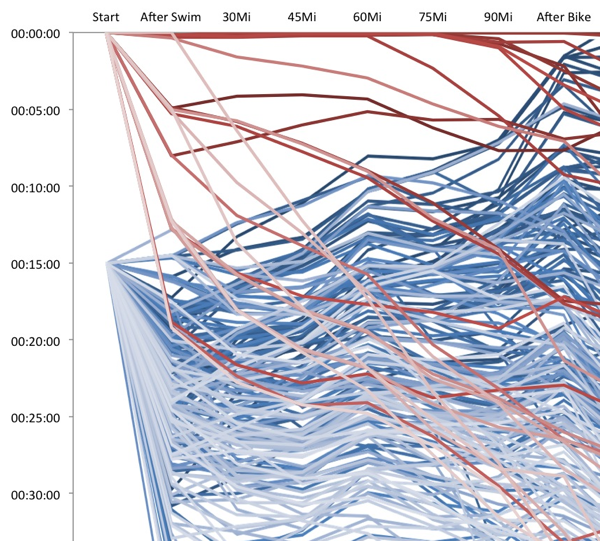
How bad would a 15 minute gap have been? Here’s the graph (for a general description and comparison to the 20 and 25 minute graphs, please check out my initial analysis) for a 15 minute gap:

2013 Mixing WPRO AGs 15

It’s pretty obvious that the back end of the Pro Women would be in the middle of Age Group Men starting from the end of the swim. Also, the front of the Pro Women’s race would have been caught by the top age groupers towards the end of the bike – though not the leaders.

However, I think the gaps between the AG men around the Pro women wouldn’t be worse at 15 minutes than at 20 minutes:

  • The number of athletes up to five minutes in front of Linsey Corbin (10th finisher) in T2 would change from 42 to 48 – not a substantial change.
  • Similarly, Mirjam Weerd (25th finisher) would have to deal with 85 instead of 104 athletes – more or less a statistical blip, as most five minute groups in T2 have about 100 athletes.
Here is a table comparing my assessments of the three different gaps that have been suggested:
25 minutes 20 minutes 15 minutes
Front of Race clean clean minimum impact
10th place small impact medium impact medium impact
Back of Race medium impact large impact large impact

Essentially, the 20 minute gap is more similar to the already rejected 15 minute gap than to the preferred 25 minute gap. So even if 20 minutes sounds like a fair compromise between 15 minutes and 25 minutes, it really isn’t. I don’t think that a lot of this data was apparent at the time that the gap was discussed, and I hope that the last word has not been spoken for 2014.

Select your currency
EUR Euro
USD United States (US) dollar

By continuing to use the site, you agree to the use of cookies. more information

The cookie settings on this website are set to "allow cookies" to give you the best browsing experience possible. If you continue to use this website without changing your cookie settings or you click "Accept" below then you are consenting to this.

Close