Skip to content

Analysis

Updated TOP10 Ratings and Course Ratings

After the Kona and Florida races (and some minor adjustments in my methodology), I’ve updated the TOP10 Ratings and Course Ratings pages. I will probably post a longer analysis in my planned end-of-year rating report, but here are some highlights:

  • Andreas Raelert is back in the #1 spot. (He slipped to #2 after Crowie’s great race in Melbourne and his sub-par race in Frankfurt, but the Kona results moved him back to the top.)
  • On the women’s side, Chrissie got dropped from the rankings (no race for more than a year). My new #1 is Rinnie, even if she is only slightly ahead of Mary Beth Ellis and Caroline Steffen.
  • On the course ratings side, I still have to do some catching up for the summer races, but IM Sweden is currently the fastest course (although with just one race so far we may see some changes next year).

Any suggestions and observations are welcome!

SwimRatings – How did I calculate them?

My latest blog post on the development of Heather Wurtele’s swim times has generated some interest. Rather than explaining how I calculated the Swim Ratings in comments or private emails, I’ve decided to write a longer, technical blog post explaining the algorithm I’m using. Here are the steps to process new results:

  1. Calculate the race adjustment
  2. Adjust the individual times
  3. Calculate the new rating

Each of these steps is explained in more detail in the following sections. As an example, I’m using Heather’s results from IM Lake Placid 2011 in order not to overwhelm you with lots and lots of results. (Lake Placid had 24 Pros, her later races had way more.) The description also applies to my calculations for any of the legs in a triathlon or the total time, but as the question was specific to swim results, I’ll use the swim times as an example.

Calculate the race adjustment

The goal of the race adjustment is to figure out if the race was slow or fast, taking things into account like how accurate the course was measured or how conducive the conditions on race day were for fast times. In order to calculate this number, let’s have a look at the actual results (Pros, both men and women) first:
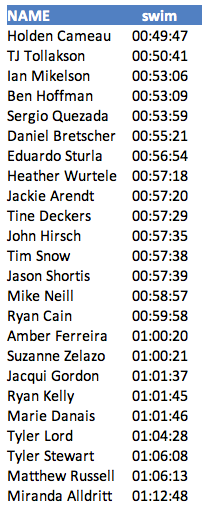
Swim

The next step is adding in the existing swim rating. (Some athletes haven’t got a swim rating yet, these can’t be used for the adjustment calculation.) Then I can calculate the difference between the rating and the actual swim time and calculate the difference in percent of the rating. Here’s the data after resorting the table based on the percentage:
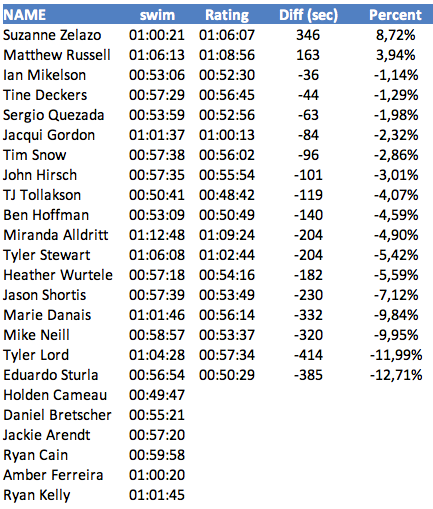
SwimDiffs

Only two athletes were able to beat their swim rating (compared to 16 that took longer), so you can already see that the swim was “slow”. There are a few statistical tricks to come up with a “fair” overall adjustment, such as using the average (-4,23%) or the median (-4,33%). What I’ve found works best is to use a percentage of athletes closest to the median. This way larger variations than what we have in this data set (aka. “explosions” on the run) do not play such a big role. Here I end up with a swim adjustment of -4,51%. 

Adjust the individual times

Once we have calculated the race adjustment, we can apply this adjustment to the individual times:
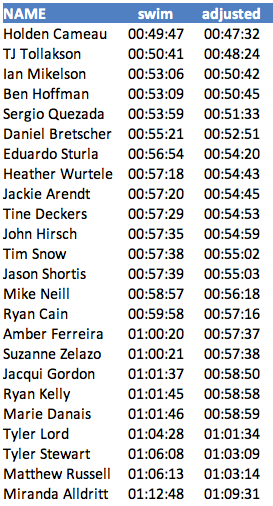
Adjusted

Basically we have removed all course and condition factors from the time and have arrived at a “neutral” swim time that is comparable between races held on different courses and in different years.

Calculate the new rating

Now that we have calculated an adjusted swim time for each athlete’s results, we can pull all of these individual results into a swim rating. To continue with the example, here are Heather’s swim results and adjusted swim times up to Lake Placid 2011:
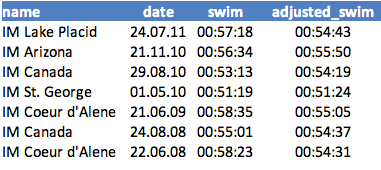
HeatherSwims

(We can also see that the results Heather based her original assessment on – St. George 2010 – was by far her best swim result.)

The simplest solution is to just take the average of all the results. But then an old result has the same influence as a new result – which doesn’t help much in assessing the current capabilities of a developing athlete or an athlete way past his prime. Therefore, I’m assigning each result a weight based on how old the result is – the older the result, the lower the weight is. I’ve found a value of 0.75 per year works well at reflecting current capabilities without making the ratings change too much. For Heather’s results, the difference between an average and my method is small (54:21 vs. 54:22) but there are examples where the difference is meaningful.

Summary

I hope that I was able to explain in detail how I came up with the swim numbers that form the basis of my blog post comparing the different swim results. The calculation itself is pretty complicated and takes a lot of factors and situations into account. This has the disadvantage of making it almost impossible to calculate the numbers by hand, but so far I have not seen a better system. I accept that these numbers might not be “true” and cannot reflect the assessment of an athlete by a trainer who sees the athlete much more often than the few times per year an athlete can race in an Ironman. But a race is where “the rubber meets the road” and where an athlete has to show what all the hard training has been worth. The numbers just indicate whether there was an improvement or not and cannot judge the reasons behind it. Also, I can’t assess the future improvements of an athlete or the quality of a training program. I certainly wish Heather some improvements in her swim time (and overall results), and I’m sure she is busy planning with Paulo on how to improve.

Kona 2012 – Swim Time Analysis for Heather Wurtele

On her blog, Heather Wurtele wrote that she was frustrated about her swim time in Kona:

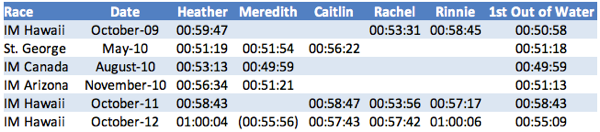
In 2010 I swam a 51 min IM swim in St. George, beating Meredith Kessler out of the water. I also used to be in front of Caitlin Snow out of the water, pretty much guaranteed  These two ladies now soundly kick my ass. … Their improvement highlights my stagnation.

Here’s the data that Heather’s statement is based on:

SwimTimesShort

(I put Meredith’s Hawaii time in brackets as she didn’t finish this year after a bike crash.)

Heather’s coach, Paulo Souza, replied with an analysis of the Kona swim times:

  • Your time difference to the best time has decreased both in 2011 and 2012
  • Your time difference to the most consistent performer in the years you raced Kona (Rachel Joyce) has decreased in 2011 and 2012.
  • Your time difference to the best athlete in that list (Mirinda) has also decreased from last year to this year.

He comes to the following conclusion:

I think the data shows your clear progression in the last couple years.

As I have started to analyze swim/bike/run times (in addition to the total finishing times), this discussion inspired me do have a closer look at the data. First, here’s a look at the swim times where Heather was racing with one of the ladies mentioned:

SwimTimesLong

(The table is just a comparison with Heather’s results; of course, the other athletes have more results than these.)

From this table, it looks that the only time Heather was swimming faster than Meredith and Caitlin was St. George 2010, and she was “soundly kicked in the ass” (her words) in this year’s Kona. But what should be considered “normal” .. was St. George the exception or Kona 2012? Another question is what influence the different courses have. Obviously the differences in the swim time largely stem from the fact that Kona (as an ocean swim with swell and currents) is slower that the lake swims in St.George, Canada or Arizona. Also, how accurately a course is measured is also an influence.

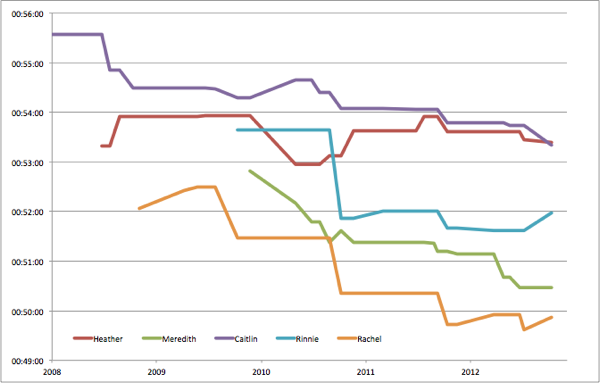
I’m trying to account for all of these factors by calculating an adjusted swim time (similar to the adjusted total time I use for my ratings). The adjusted swim times of an athlete can then be averaged to a swim rating. Here is a look how the swim ratings of Heather and the others ladies has developed over the years:

SwimRating

A couple of observations from this graph:

  • The red line is mainly horizontal, which means that Heather’s swim rating hasn’t changed much between 2008 and 2012.
  • Meredith’s swim rating (green line) has steadily improved from 2010 to 2012, she is about three minutes quicker than Heather (and Caitlin) now
  • Caitlin (purple line) has also improved, she used to be two minutes slower than Heather and has improved to be faster by a few seconds. (But nowhere close to “soundly kicking my ass”, at least not in Ironman races.)
  • Rinnie (blue line) made a big step (almost two minutes) after her first Ironman, she has been pretty steady since then.
  • Rachel (orange line) is the best swimmer of these five athletes, she steadily improved until last year and is pretty steady at a sub-50-minutes rating since then.

All in all, the data agrees more with Heather’s assessment that her swim hasn’t improved, while other athletes managed to get better. Of course, the data is purely looking at the times – other factors such as how much effort was required cannot play a role here. If Paulo’s observation about her improved pool times is correct, maybe Heather can swim a bit harder without sacrificing too much bike or run time, or we can look forward to a breakthrough performance from Heather in one of her future Ironman races. For the next months,I think she correctly predicted when she wrote:

Oh my god, I am going to suffer in the water this winter!!!!!  🙂

Heather, enjoy your off-season!

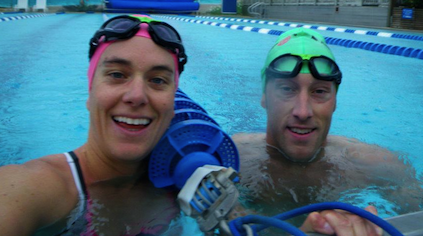
HeatherSwim

(Photo from her blog.)

Changes for the Kona Pro Ranking 2013 (KPR) – Updated

Almost by accident I noticed that WTC has already posted points and rules for the 2013 KPR. After a quick scan here are the changes I noticed:

  • The number of Kona slots for female PROs has been increased by 5 (28 by July, another 7 by August). The number of male PROs stays the same (40+10 = 50).
  • St. George is no longer on the schedule as a full distance race – this has been announced for a while.
  • New York has also been cancelled – this is a relatively recent development, it was announced a few days ago (i.e. early September).
  • Canada is also no longer on the list – the old venue has become a Challenge event, and the new event hasn’t been announced yet. I’m sure WTC has a few slots saved for a Canadian race.
  • The new Ironman Canada in Whistler has been designated a 2000 points race. (The 2012 race in Penticton was just a 1000 points race.)
  • IM Regensburg is also absent. The race site has not announced a new date yet, and there is lots of speculation in the German triathlon forums if and when the race is going to be held. The race has been officially canceled for 2013.
  • One more thing that is missing for now: A North American Championship race (i.e. a 4.000 points race with a similar status to Melbourne and Frankfurt).
  • The race in Mont Tremblant has been designated the new North American Championship race (i.e. it is now a 4.000 points race).
  • There are also two new races: Los Cabos (March) and Lake Tahoe (September, a qualifier for 2014), both are 2.000 points races.
Select your currency
EUR Euro
USD United States (US) dollar

By continuing to use the site, you agree to the use of cookies. more information

The cookie settings on this website are set to "allow cookies" to give you the best browsing experience possible. If you continue to use this website without changing your cookie settings or you click "Accept" below then you are consenting to this.

Close