Skip to content

Analysis

Unofficial KPR & 2016 Pro Kona Slot Allocation for July Cutoff
2016 Kona Rating Report Title Thumb

Here is my calculation of the KPR at the end of July, deciding 40 male and 28 female slots (in addition to the Automatic Qualifiers). My results are unofficial, the official results will be posted on the Ironman website at http://eu.ironman.com/triathlon/triathlon-rankings/points-system.aspx (but as far as I can tell shows the same data). I do not count AQs and athletes that haven’t validated my rankings, therefore it is a bit easier to determine the Top 40 male and Top 28 females. I will update this post with new information regarding declined slots and rolldown. For now, the athletes with a rank in brackets (e.g. “(42)”) are outside of the July slots. I will update this post with information about slot declines and rolldowns.

There is another cutoff in August, adding another 10 male and 7 female slots. Once the field has been completed, I will work on this year’s version of the Kona Rating Report, looking at the field and each athlete’s chances for a good result. The free report will be released in time before the Kona race, you can already pre-order your copy.

Update July 28th: The first rolldown has happened: Carrie Lester is now marked as a qualifier as well. It’s unclear who has declined her slot, I have marked the female qualifiers without a “Q” on the Ironman site with a question mark. (So even though Carrie is still ranked 29th in my table, she did get a slot.)   So far there is no indication for a rolldown on the men’s side.

Update July 29th: It is now clear that the slot that rolled down to Carrie was declined by Michelle Bremer. I’ve added a “D” to her name and adjusted the other ranks accordingly.

Update August 2nd: All male slots have been sorted. One slot rolled down to Jens Petersen-Bach, as far as I can tell Matt  Trautmann had to decline his slot. All other slots have been accepted.

Update August 3rd: One more slot rolled on the female side, Emma Balham declined and Jodie Robertson accepted the roll-down slot. All July slots on the female side are finalized as well.

Update August 3rd: Just when everything seemed clear, Beth Gerdes declined her slot (details on her blog), and another slot rolled down to Dimity-Lee Duke.

Male KPR Rankings


Rank Name Points Races
AQ Frodeno, Jan 13350 2+2
AQ Kienle, Sebastian 12440 2+3 (3825/640)
AQ McMahon, Brent 10615 3+2 (1600/785)
1 Potts, Andy 9520 2+3 (2000/435)
AQ Van Berkel, Tim 8985 2+3 (3400/400)
2 Llanos, Eneko 8525 3+2 (290/345)
3 Sanders, Lionel 7370 2+3 (1620/750)
4 O’Donnell, Timothy 7325 2+2
5 Don, Tim 7025 2+2
6 Boecherer, Andi 6870 2+3 (450/500)
7 Butterfield, Tyler 6855 2+1
8 Russell, Matthew 6650 3+2 (720/180)
9 Stein, Boris 6440 2+2
10 Viennot, Cyril 6170 2+2
11 Dellow, David 5975 3+1 (960/0)
AQ Hoffman, Ben 5605 2+3 (340/280)
12 Albert, Marko 5550 3+1 (120/0)
13 Cunnama, James 5225 2+3 (1600/400)
14 Aernouts, Bart 5045 1+3 (720/640)
15 Collington, Kevin 5035 2+3 (405/320)
16 Bozzone, Terenzo 4945 2+3 (540/435)
AQ Lange, Patrick 4845 1+3 (4000/125)
17 McKenzie, Luke 4675 2+3 (1670/45)
18 Thomschke, Markus 4605 2+3 (1280/345)
19 Bracht, Timo 4595 3+2 (540/135)
20 McNamee, David 4590 2+2
21 Schmid, Stefan 4560 3+0 (1280/0)
22 Thomas, Jesse 4545 2+2
23 Reed, Tim 4475 1+3 (2000/640)
D Trautman, Matt 4470 1+3 (2455/515)
24 Degasperi, Alessandro 4460 3+2 (1280/220)
25 Wild, Ruedi 4435 1+3 (1670/500)
26 Gomes, Pedro 4397 3+1 (705/0)
27 Schildknecht, Ronnie 4190 3+0 (855/0)
28 Weiss, Michael 4095 3+2 (960/320)
29 Kotshegarov, Kirill 4068 3+1 (60/0)
30 Plese, David 4045 3+2 (305/100)
31 Baertsch, Mauro 4025 3+2 (540/180)
32 Skipper, Joe 3935 2+1
33 Kramer, Christian 3780 3+2 (540/100)
34 Vistica, Andrej 3770 3+2 (720/30)
35 Rana, Ivan 3745 2+1
36 Van Berkel, Jan 3735 3+2 (235/240)
37 Chevrot, Denis 3735 2+2
38 Wurtele, Trevor 3725 2+3 (540/625)
39 Bittner, Per 3620 2+3 (1280/75)
40 Petersen-Bach, Jens 3610 3+1 (685/0)
(41) Millward, Callum 3580 2+3 (685/435)
(42) Wiltshire, Harry 3495 3+2 (720/135)
(43) Billard, Bertrand 3490 2+2
AQ Jacobs, Pete 3055 1+2
AQ Van Lierde, Frederik 2335 2+3 (340/135)

Female KPR Rankings

Rank Name Points Races
AQ Ryf, Daniela 15250 2+3 (2000/750)
1 Cheetham, Susie 10140 2+3 (3400/180)
2 Jackson, Heather 8790 1+3 (2000/500)
3 Gossage, Lucy 8740 3+1 (2000/0)
4 Piampiano, Sarah 7825 2+3 (2000/435)
AQ Gajer, Julia 7450 2+2
5 Frades Larralde, Gurutze 7070 3+2 (1600/180)
6 Pedersen, Camilla 6730 2+3 (1280/345)
7 Roberts, Lisa 6715 2+3 (1600/30)
8 Vesterby, Michelle 6605 2+1
9? Luxford, Annabel 6580 2+3 (2090/750)
10 Lundstroem, Asa 6575 2+2
11 Kessler, Meredith 6475 2+3 (2000/640)
AQ Lyles, Elizabeth 6465 2+3 (1620/180)
12 Beranek, Anja 6455 1+3 (2000/750)
AQ Swallow, Jodie 6420 1+3 (4000/750)
13 Konschak, Katja 6140 3+1 (1280/0)
AQ Lehtonen, Kaisa 6140 2+1
14 Kaye, Alicia 6055 2+3 (1280/280)
15 Wurtele, Heather 5910 1+3 (960/750)
16 Hufe, Mareen 5750 3+2 (405/125)
17 Corbin, Linsey 5590 1+3 (3400/320)
18 Crowley, Sarah 5535 2+3 (960/435)
19 Deckers, Tine 5440 2+3 (1600/500)
D Bilham, Emma 5355 2+3 (1600/240)
20 Saemmler, Daniela 5290 2+1
D Bremer, Michelle 5285 3+2 (540/345)
21 Van Vlerken, Yvonne 5200 2+3 (1280/640)
22 Holst, Tine 5185 3+1 (960/0)
AQ Hauschildt, Melissa 4750 1+1
23 Monticeli, Ariane 4715 2+3 (720/500)
24 Walter, Verena 4600 3+1 (405/0)
25 Tondeur, Alexandra 4530 2+3 (1280/435)
D Gerdes, Beth 4490 2+3 (1375/280)
26 Lester, Carrie 4420 2+2
27 Robertson, Jodie 4305 1+3 (3400/240)
28 Duke, Dimity-Lee 4215 3+2 (960/320)
(29) Steurer, Bianca 4090 3+2 (855/400)
AQ Cave, Leanda 3520 2+1
AQ Carfrae, Mirinda 3260 1+3 (2000/320)

KPR Situation Before the Last July Races

Update July 20th: In the latest startlists a few names have been removed. I have crossed them out in the tables below.

The race for the first round of Professional Kona slots is almost over – the July qualifying period that decides 28 female and 40 male slots ends on July 24th. There are only three more Ironman races (Switzerland, Lake Placid as WPRO only and Whistler as MPRO only) and one more 70.3 race (Calgary) before the first cutoff. This post looks at the final slots to be decided based on the rankings before the last weekend and the start lists posted on the Ironman website.

After the races are over, I’ll post the unofficial rankings based on my calculations as soon as possible. (The women’s ranking is already up.)

Women’s Qualifying

Assuming that Heather Jackson validates her slot by finishing in Lake Placid, Ariane Monticelli is currently in the last points qualifying spot. Here’s a table looking at the athletes close the cutoff and those on the startlists with a chance to overtake her:

Rank Name Country Points Races Race Plan Needed
24 Walter, Verena DEU 4.600 3+1 (405/435)
25 Tondeur, Alexandra BEL 4.530 2+3 (1280/435)
26 Gerdes, Beth USA 4.490 2+3 (1375/280)
27 Lester, Carrie AUS 4.420 2+2
28 Monticeli, Ariane BRA 4.335 2+3 (340/500) IM Zürich
29 Robertson, Jodie USA 4.305 1+3 (3400/240) 70.3 Calgary,
IM Lake Placid
3rd,
14th
33 Bilham, Emma CHE 3.755 1+3 (1600/240) IM Zürich 5th
35 Williamson, Kelly USA 3.215 2+1 IM Lake Placid 3rd
36 Grohmann, Katharina DEU 3.205 3+1 (855/320) IM Zürich Win
37 Moeller, Kristin DEU 3.145 2+1 IM Zürich 3rd
38 Badmann, Natascha CHE 3.095 2+2 IM Zürich 3rd
47 Herlbauer, Michaela AUT 2.585 2+2 IM Zürich Win

(Please note that “Needed” is the minimum result needed for qualifying, however it does not assure a slot when others add points as well.)

With Daniela Ryf also on the start line in Zürich, here’s my best guess at who is going to receive one of the open five July slots:

  • Verena Walter remains in the Top 28 (1). (It is possible but quite unlikely for her to drop out of the Top 28.)
  • Jodie Robertson should be able to finish at least in the Top 10 in Lake Placid 3 in Calgary (2).
  • Zürich is the race with the most athletes looking for slots, with probably two athletes racing well enough for a slot – possibly Ariane Monticelli and one of Emma, Kristin and Natascha (3 & 4).
  • The last slot would then go to Alexandra Tondeur – but she could be overtaken when more of the Zürich athletes finish well (5).

This would mean that Beth Gerdes and Carrie Lester would drop out of the July slots and that they would have to hope for a rolldown slot.

Men’s Qualifying

Assuming that Andy Potts validates his slot by finishing in Lake Placid, David Plese is currently in the last points qualifying spot. Here’s a table looking at the athletes close the cutoff and those on the startlists with a chance to overtake him:

Rank Name Country Points Races Race Plan Needed
31 Vistica, Andrej HRV 3.770 3+2 (720/30) IM Zürich
32 Rana, Ivan ESP 3.745 2+1
33 Chevrot, Denis FRA 3.735 2+2
34 Bittner, Per DEU 3.620 2+3 (1280/75)
35 Petersen-Bach, Jens DNK 3.610 3+1 (685/115)
36 Millward, Callum NZL 3.580 2+3 (685/435) IM Whistler
37 Wiltshire, Harry GBR 3.495 3+2 (720/135) IM Zürich
38 Billard, Bertrand FRA 3.490 2+2 IM Zürich
39 Chrabot, Matt USA 3.470 2+3 (235/345)
40 Plese, David SVN 3.415 3+2 (90/100) IM Zürich
41 Matthews, Paul AUS 3.225 1+3 (2455/145) 70.3 Calgary 2nd
43 Bracht, Timo DEU 2.995 2+2 IM Zürich 6th
46 Gomes, Pedro PRT 2.797 2+1 IM Whistler 5th
48 Zyemtsev, Viktor UKR 2.575 1+2 IM Whistler 4th
49 Aigroz, Mike CHE 2.555 2+3 (120/75) IM Whistler 4th
54 Carvalho, Fabio BRA 2.460 1+3 (1670/135) IM Zürich 4th
55 Van Berkel, Jan CHE 2.455 2+2 IM Zürich 3rd
56 Wurtele, Trevor CAN 2.445 1+3 (540/625) IM Whistler 3rd
62 Schildknecht, Ronnie CHE 2.190 2+0 IM Zürich 3rd
63 Brader, Christian DEU 2.099 3+1 (405/9) IM Zürich 2nd
66 Daerr, Justin USA 2.030 2+1 IM Whistler 2nd
84 Collins, Benjamin USA 1.635 2+3 (60/125) IM Whistler Win

Based on the available start lists, here’s my best guess at who is going to receive one of the open ten July slots:

  • The athletes currently in #31 to #34 (Andrej, Ivan, Denis and Per) will remain in the Top 40
    (1 to 4).
  • Three of the Whistler athletes will finish well enough for a slot – maybe Callum, Pedro and Viktor Mike (5 to 7).
  • At least two of the Zürich athletes will finish well. If I had to pick two, I’d go with Ronnie Schildknecht and Timo Bracht (8 and 9).
  • The last slot should be decided Jens Petersen-Bach and one other Zürich athlete (10).

But there are so many different scenarios that it’s still possible for any of the athletes in the above table to get a slot or drop out of the slot ranks– it’ll be exciting racing on Sunday!

Pros Battling Hypothermia in Non-wetsuit Swim at IM Frankfurt

This year’s IM Frankfurt produced a number of DNFs due to hypothermia when there was a non-wetsuit swim for the Pros because of high water temperatures. This post goes into some more detail on what happened, my best understanding of the current rules and some suggestions for avoiding more occurrences of this issue. I hope that this post can add some details to the discussion that needs to happen.

Temperatures at Langener Waldsee

In the days before Ironman Frankfurt there was a lot of speculation if the Pro swim would be without wetsuits. The cutoff temperature for the Pro race is 21.9°C (71.5°F). As the temperature was hovering around this mark, the final decision would be made on race day morning. I was out at the “Langener Waldsee” on Wednesday when the posted water temperature was 21.8°C. After a few nice warm days it was already at 22.1°C on Friday and on Saturday it had risen to 22.5°C. But Saturday was cloudy and had some rain, so it was a surprise that on Sunday morning the official temperature was announced as 22.6°C (even higher than Saturday) and the race was to start with a non-wetsuit swim.

Among local athletes who swim in the Langener Waldsee on a regular basis it is well known that there are warmer and colder spots in the lake and that temperatures can vary quite widely depending on where you measure. According to the rules the water temperature is to be taken “at the middle of the course and in two other areas on the swim course, at a depth of 60 cm. The lowest measured temperature will be considered as the official water temperature.”

According to ITU rules, the air temperature also plays a role. While I am not aware of any official measurements, air temperature was somewhere around 12°C before the race started and 14°C at the time that athletes started the bike.

There are some reports that the life guards at the Langener Waldsee measured a temperature of 21.5°C on Sunday. After a cold and rainy race day the temperature dropped pretty quickly, on Monday it was posted at 21.0°C and 20.3°C on Tuesday.

Pro Athletes in Trouble

After the decision to not allow the use of wetsuits for the Pros, a lot of Pro athletes were struggling in the swim. The most public case was Daniela Ryf who was leading the women’s race after the swim but couldn’t get warm and had to abandon the race after an hour on the bike because of hypothermia.

There were a lot more athletes that struggled with the cold and DNF’d on the bike. Some athletes even had to be rescued on the swim, close to becoming completely disoriented and loosing consciousness. At least two athletes were sent to the hospital when their low body temperatures raised serious concerns with the lifeguards.

WPro Bikes

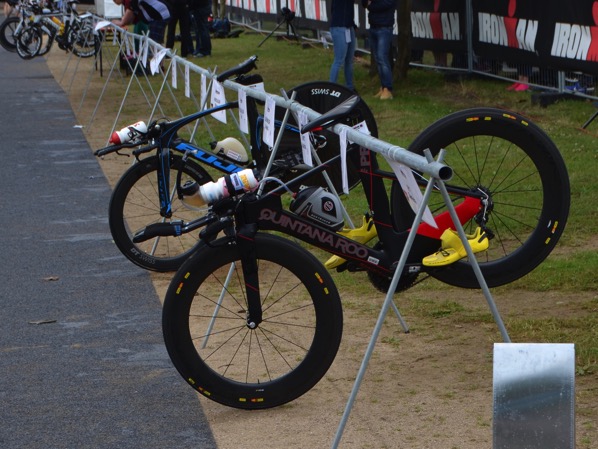
(Photo: The lonely bikes of Kristin Möller and Diana Riesler in T1 after both had to be rescued during the swim.)

Brett Sutton has written about the issue as well and included a list of athletes that DNF’d because of the cold – making it clear that both men and women struggled in the water. An even larger number of athlete’s races were affected, here’s a short excerpt from Caroline Livesey’s race report (she went on to finish 12th in the female Pro race) about the end of her swim:

Determination kept me going but coming into T1 I knew I was in a bad way. I couldn’t really think straight so I just went onto auto pilot and transitioned onto the bike leg. I am pretty sure if anyone medically trained had stopped and checked me over I would have been delirious and probably have been pulled from the race. Apparently spectators were wondering out loud how on earth I was going to run a marathon when I could barely run in T1.

It is obvious from the number of athletes struggling that this is not a gender-specific issue and that the official water temperature was not an accurate reflection of conditions on race morning. Racing without a wetsuit should avoid overheating on the swim, but the dangers of hypothermia were clearly much bigger for the Pro athletes in Frankfurt.

Wetsuit Rules

Before offering some ideas on how to avoid a situation as in Frankfurt, it’s a good idea to review the rules as they stand.

The applicable rules for Ironman races state in Section 4.02 (Wetsuit Rules):

(a) For professional athletes, wetsuits may be worn in water temperatures up to and including 21.9 degrees C/71.5 degrees F;

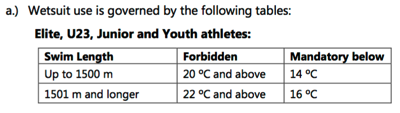
The cutoff temperature was reduced from 76.1 degrees Fahrenheit (24.5 degrees C) in 2014 to align more closely with changes in the ITU rules. These are as follows (Section 4.2 Wetsuit Use):

ITU Wetsuit

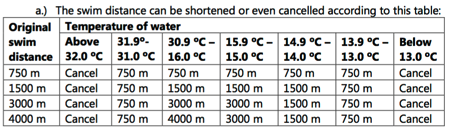
In addition the ITU rules have a section (Section 4.3 Modifications) on shortening or cancelling the swim in certain conditions:

ITUShortening

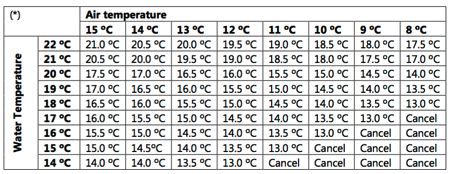
Air temperatures also play a role on how big the danger of hypothermia is – in cold temperatures athletes will be shivering in the final minutes before the race start, and it becomes much harder to dry and get warm once on the bike. Therefore Section 4.3 also contains a table that shows how to decrease the measured water temperature to account for low air temperatures:

ITUAdjustTemperature

However, this table only applies for water temperatures below 22°C and – at least the way I understand the wording of the rules – is only to be used in determining to shorten or cancel the swim, but not for the decision to allow a wetsuit or not.

In order to to deal with special conditions not covered by the previous rules there is a catch-all rule (also in Section 4.3) that gives extra powers to the referees:

b.) If other weather conditions dictate, i.e., high winds, heavy rain, changing temperature, current, etc. the Technical and Medical Delegates may adapt limits of the swim length or adopt provisions about the use of wetsuit.

However,  I’m not aware of a similar provision in the Ironman rules and it was not invoked on race morning of IM Frankfurt.

To sum up, if the measured water temperature of 22.6°C is deemed correct, then the current rules directly imply a non-wetsuit swim.

Suggestions

If the current rules in place put athletes in danger as has happened in Frankfurt, obviously they need to be changed to avoid similar occurrences.

Rethink the Cutoff Temperature for IM Racing

Ironman has much bigger experience in organizing long-distance triathlons than the ITU that is primarily concerned with racing on the Olympic Distance. The ITU rules make a distinction between Olympic Distance swims (1.5k) and those longer, but of course there is a large difference between racing a 70.3 swim (1.9k) and an Ironman swim (3.8k), and the use of wetsuits in Professional long-distance races seems to be an issue that both organizations should discuss and maybe adjust their rulebooks.

Uniformly Adjust the Water Temperature

Rather than simply adjusting the cutoff temperature as discussed in the previous section, my suggestion is to extend the water temperature adjustment procedures and base all decisions off that modified temperature. In order to be used for these cases the table needs to be extended for warmer water temperatures, at least up to 25°C or even higher to make the table applicable for agegroup racing as well. (To my engineering mind, there’s also no clear description on which row/column to use, for example does a temperature of 22.6°C correspond to the row of 22°C or should it be rounded up and then correspond to the 23°C row.) This would still not address situations with large differences between warm water and cold air temperatures (for example 25°C water and 8°C air temperature), so Ironman rules should allow referees to make a call on race day.

If we assume that this modified temperature rule was in place and there was an air temperature of 15°C (it probably was even lower an hour before the start), then the adjusted temperature would be 21°C, clearly under the Pro cutoff temperature. If this adjusted temperature had been used in making the decision about allowing wetsuits, IM Frankfurt would have been a wetsuit race and most of the issues we saw could have been avoided.

Discuss with the ITU, Federations and Ironman

Of course change is not going to happen on its own, so Pro athletes, coaches etc. have to make  the ITU, their local federations and Ironman aware of this issue and encourage them to better address it in the rules. While I have suggested a possible solution above, there may be other (and better) ways of updating the rules. An open discussion about the changes would surely be appreciated by many athletes, especially those that barely escaped without lasting damage from racing an Ironman.

What Happened to GPS Coverage of the Pro Races?

In January 2015 Ironman announced enhanced race coverage of major races, including GPS tracking devices feeding into a new athlete tracking platform (see my post looking at the details). This post looks at the progress Ironman has made during last year and where things are for this season.

2015 Season

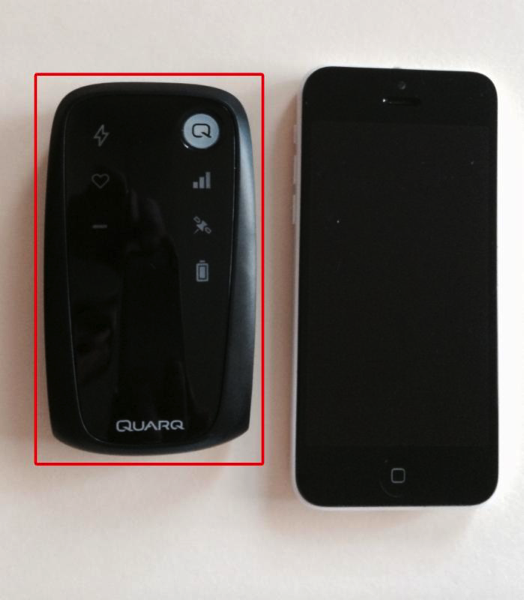
GPS tracking was off to a slow start. At the Regional Championships Pros were given a tracker that they had to carry on the bike and run. The following photo shows the tracker on the left compared to an iPhone 5 (the photo doesn’t show that the tracker is about three times as thick as an iPhone):

OldTracker

The Pros had to carry the devices, but for the first Regionals the information was not made publicly available. If you knew where to look, you could see “dots on a map” on a “semi-secret” site by Quarq, the manufacturer of the devices.

Towards the second half of the season (as far as I know starting with IM Frankfurt but also for 70.3 Championships and Kona) the information was integrated into the Ironman website and there was a GPS Leaderboard with constantly updating information showing the time differences between athletes. The old “Athlete Tracker” was replaced by a modernized version with a slicker look and predictions that often were comically wrong. For agegroup athletes the information was still based on the splits from the timing mats.

2016 Season

I was expecting to a see an updated version of the GPS tracking for this season, both in terms of the tracking device (smaller, lighter) and also in the functionality offered to the public. But the first Regional Championships at IM South Africa did not include any GPS information at all, neither publicly not privately.

I reached out to Ironman with some detailed questions but only received a short answer that “there was an issue for the IRONMAN African Championships” and that they are “working to have GPS tracking at the remaining Championship races”.

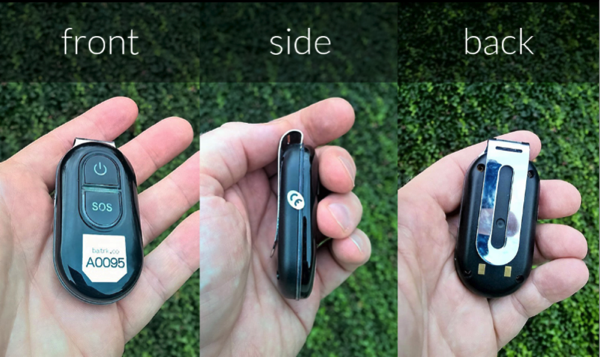
The North American Championships at IM Texas did in fact provide GPS tracking. A new, smaller device was used:

NewTracker

Apparently these are provided not by Quarq (who continue to offer their race tracking services, for example at Rev3 races as announced in this press release) but by Beacon Athlete Tracking. (I have contacted Beacon Athlete Tracking and they confirmed to be working with Ironman this season to provide GPS tracking but haven’t provided additional information.) Similar to the start of last season, there was a “semi-secret” website for IM Texas with dots on a map but no GPS leaderboard, and no information was available on the Ironman website. Also, the old and much-ridiculed Athlete Tracker was used to show leaderboards and splits for all racers. As has often happened in the past, the tracker had issues and the first two hours of the race no information or splits were available.

My Assessment

One can only assume that Ironman and Quarq had reasons not to continue their relationship, however it is extremely unfortunate that the biggest fans of Ironman racing – those watching the race on site and those trying to follow online –  have to suffer the consequences. So far triathletes following the Regional Championships had to rely on spotter updates from the course and the spotty tracker – very infrequent split information that is not easily available. I can only assume that this also makes the job of the two commenters of the live show, Greg Welch and Michael Lovato, that much harder. Basically things are back to were they were at the start of 2015 and all the progress made during last year has been lost.

While Ironman has stated that they remain committed to providing GPS Tracking for the Pros and their intention to extend that to agegroupers as well, it is hard to discern that from their actions. I hope that they can make quick progress in the next few weeks and at least get us back to the status we had last summer with a working GPS leaderboard and an updated Athlete Tracker for Ironman Frankfurt.

In last year’s post I wrote:

Too often, Ironman efforts have been half-hearted and ultimately disappointing.

Concerning GPS tracking, I sincerely hope that Ironman’s actions will prove me wrong.

Select your currency
EUR Euro

By continuing to use the site, you agree to the use of cookies. more information

The cookie settings on this website are set to "allow cookies" to give you the best browsing experience possible. If you continue to use this website without changing your cookie settings or you click "Accept" below then you are consenting to this.

Close