Skip to content

Analysis

Validating 2015 Predictions

I have been publishing Race Predictions for a few years now, so it’s about time to have a look at how “good” my predictions are. When I started in 2011, there were quite a few changes in the algorithm and the parameters to deal with a number of edge cases. During 2015 there have not been any changes, so this is a good data pool for validation.

Data Used

In 2015 I have published predictions for 36 Professional Ironman-distance races, 31 Ironman-branded races by WTC and 5 more Challenge races.There have been a total of 1098 finishes, 688 by male athletes (62.7%) and 410 by females (37.3%). These were posted by 600 different athletes, 382 male (63.7%) and 218 females (36.3). In addition there were 349 DNFs, 244 by males (70%) and 105 by females (30%).

Using my algorithm and the available start lists, I have seeded the participants in each of the races, and predicted 930 finishing times (84.7% of all finishers). There are some cases when I didn’t predict the finishing times, for example when an athlete didn’t have any prior IM-distance finishes or when there was a late entry (and therefore the athlete not included in the start list).

Predicting the Winners

Here’s a look at the places the eventual race winners have been seeded based on previous results and the start lists:

WinnersSeeded

With 36 IM-distance races, there are 72 winners (one each for the male and female race). My algorithm has correctly predicted the winner in 26 races (36%), and another 26 winners were seeded in #2 or #3 (winning frequency of an athlete seeded on the podium: 72%). Only three winners have been seeded higher than 8th: Kirill Kotshegarov was seeded 10th at IM Chattanooga, Mel Hauschildt was seeded 11th at IM Melbourne, and Matt Hanson was seeded 12th at IM Texas. There was also one unrated (and therefore unseeded) winner in 2015: Jesse Thomas won IM Wales in his debut Ironman.

The numbers would be even better when only considering the athletes that finished a race. Only including athletes that actually started increases the frequency of picking the right winner to 39% (and one of the podium picks to win the race to 80%), also discarding athletes not finishing would have yielded 42% and 83% of the winners.

Time Predictions

In my pre-race posts, the finish times are predicted for each athlete that has raced an Ironman race before. The algorithm considers the previous finishing times of an athlete and the course that the race is going to be held on.

The following graph compares the actual finish times to the predicted finish times (each data point is one dot on the graph). Dots towards the upper left are results where the actual finish was faster than predicted, dots towards the lower right are results that are slower than predicted.

The graph shows actual and predicted times between 8 and 12 hours (only 11 faster results/predictions and 15 slower ones are missing).

ActualVsPredicted

I have added a “trend line” that shows the best fit of all the data points, highlighting the fact that most of the data points are pretty close to the “diagonal” (where actual = predicted). Between 8 hours and 10 hours the algorithmic predictions are pretty good on average (maybe predictions are a bit too fast around 8 hours). Towards 10 hours finishing time and especially over 10 hours the predictions are too fast: This is caused by “explosions” that lead to very slow times even for athletes that have been predicted to be relatively fast. To put it another way: Finishing times over 10 hours are most often bad races that are pretty much unpredictable using only data.

Here is another way of looking at how far off the time predictions have been from the actual results:

Difference

The graph shows the number of results in one minute bins of difference between predicted and actual finishing times. Data points towards the right are faster than predicted, they are slower than predicted to the left. Again a trend line smoothes out the statistical “noise”.

A few observations:

  • In a range roughly between -40 minutes and +40 minutes the graph is pretty symmetric and is very close the normal distribution.
  • As noted above, there is relatively large number of “explosions” with large negative differences, resulting in a non-symmetrical distribution on the edges of the graph. (There are 49 results that are more than 60 minutes slower than predicted, but only 10 that are more than 60 minutes faster.)

On average, the predictions are -4.7 minutes off the actual finish time (i.e. the actual finish is  slower by close to five minutes). An average close to 0 means that on average the predictions are closer to the actual finish. The standard deviation is 31.8, this means that 68% of the time differences are between -36.5 and 27.1 minutes (-4.7 +/- 31.8 minutes). Usually, a smaller deviation corresponds to a “better” prediction.

The standard “statistical” way of measuring the dependence between two data sets is correlation. Correlation is +1 in the case of a perfect linear relationship, −1 in the case of a perfect inverse relationship, and some value between −1 and 1 in all other cases, indicating the degree of linear dependence between the variables. A value around zero indicates that there is less of a relationship (closer to uncorrelated). The closer the coefficient is to either −1 or 1, the stronger the correlation between the variables. The predictions and actual finishing times have a correlation of 0.77, indicating a pretty strong dependence between the two data sets.

Comparing Other Prediction Strategies

When trying to predict a completely random event (the classical example is a “perfect dice”), the correlation between the actual events and the predictions won’t be very high. When only working off previous results, anything that happens before a race – for example a good block of training, a slight injury – will influence how fast an athlete is able to go on race day, as will random events during the race (e.g. getting punched during the swim, technical issues on the bike). Therefore a “perfect prediction” (resulting in a correlation of 1) is impossible, and in order to determine whether a correlation of 0.77 indicates a “good predictor” or not, one has to compare the results of my algorithm to other predictions.

I am not aware of anyone other than me publishing time predictions for Ironman races on a regular basis. (Please let me know if there is!) Therefore, I am comparing my predictions to a few much simpler strategies:

  1. Last Finish: “You are only as good as your last race” (prediction = last IM-distance finish)
  2. Best Finish: “My best time is a sub-x” (prediction = fastest IM-distance finish)
  3. Average Finish: “I usually finish around y” (prediction = average IM-distance finish)
  4. Average Last Year Finish: “This season is going great” (prediction = average IM-distance finish in the last twelve months)

Here’s a comparison of the correlation of these different methods and my comments:

Number of Data Points Average Difference Standard Deviation Correlation to Actual Finish Comments
Last Finish 943 -0.75 41.14 0.649 Good on average, but wide deviation and lower correlation
Best Finish 943 -21.48 39.59 0.659 Slightly better deviation and correlation, but large average difference
Average Finish 943 -0.84 35.77 0.706 Good on average, but wider deviation and lower correlation than TTR Predictions
(still better than last/best finish)
Average Last Year Finish 877 -1.89 35.08 0.706 Almost the same as the Average Finish, but applicable for fewer cases
TTR Predictions 930 -4.70 31.81 0.770 Lowest deviation, highest correlation

Summary

The Prediction Algorithm I use to calculate the expected times in my pre-race posts provides better predictions than simpler prediction strategies. My model certainly has limitations, but the large number of “successful” winner predictions and the high correlation show that the time predictions and the conclusions drawn from them are pretty much valid. I think my analysis is quite good at telling the “data part of the story”.

While the “data part” is an important (and impartial) part of the story, it is still only a part of the story. A coach or teammate that has been able to observe an athlete getting ready for a race has additional (and more current) information available – even if that is not always fully objective.

The tension between past performances, the uncertainty of a future performance, the challenges athletes face in their training and the hard work they put in to be better in their next race .. that’s why I still love following the races!

Updated Top 10 Ratings

With the release of my “TriRating Report 2015” I have also updated my Top 10 Ratings. This post describes the overall ratings, the individual discipline ratings can be found here. The Report also contains a longer discussion of the ratings and 2015 highlights.

Top 10 Women

Rank Name Nation Rating Last Race # Races
1 Daniela Ryf SUI 08:59:29 IM Hawaii on 2015-10-10 5
2 Rachel Joyce GBR 09:06:50 IM Hawaii on 2015-10-10 17
3 Mirinda Carfrae AUS 09:08:12 IM Hawaii on 2015-10-10 12
4 Caroline Steffen SUI 09:11:40 IM Hawaii on 2015-10-10 21
5 Liz Blatchford AUS 09:15:12 IM Hawaii on 2015-10-10 9
6 Eva Wutti AUT 09:15:35 IM Hawaii on 2015-10-10 6
7 Susie Cheetham GBR 09:17:03 IM Hawaii on 2015-10-10 3
8 Julia Gajer GER 09:17:12 IM Arizona on 2015-11-15 10
9 Yvonne Van Vlerken NED 09:17:31 IM Western Australia on 2015-12-06 21
10 Mary Beth Ellis USA 09:17:48 IM Hawaii on 2015-10-10 16

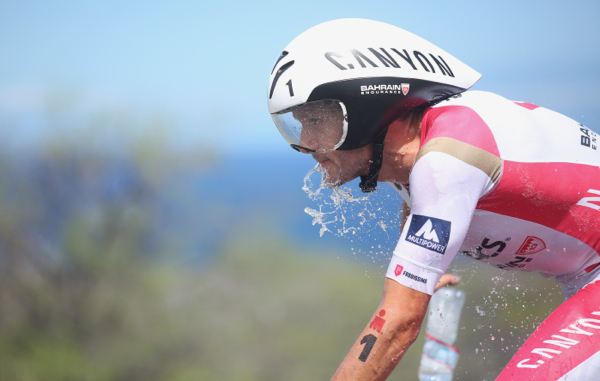
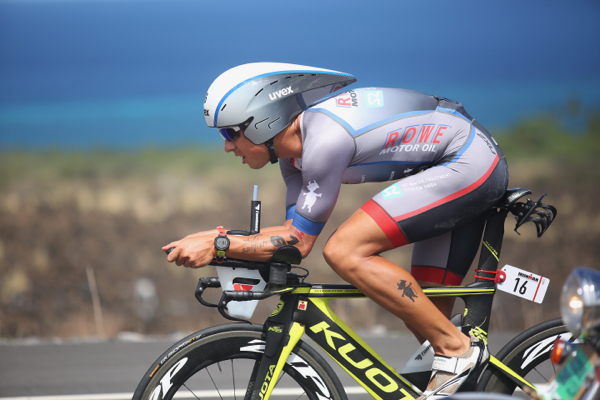
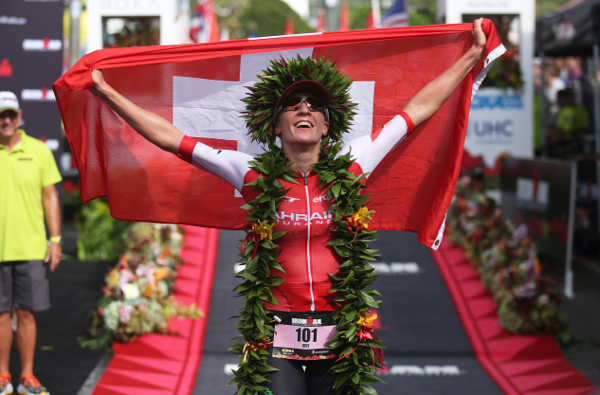
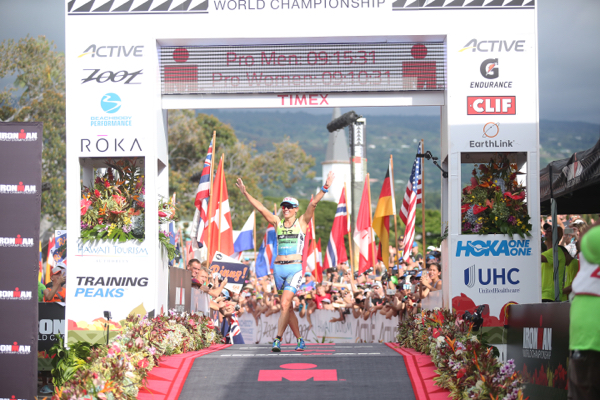
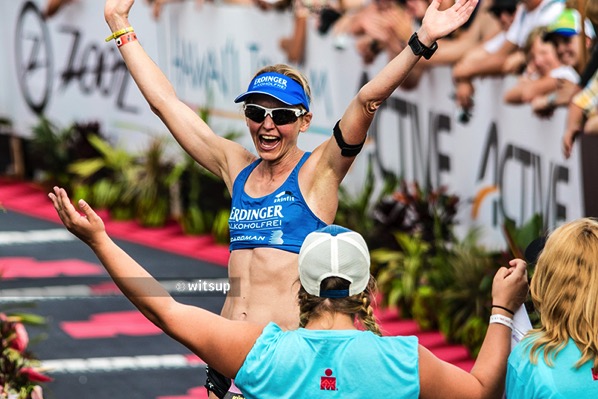
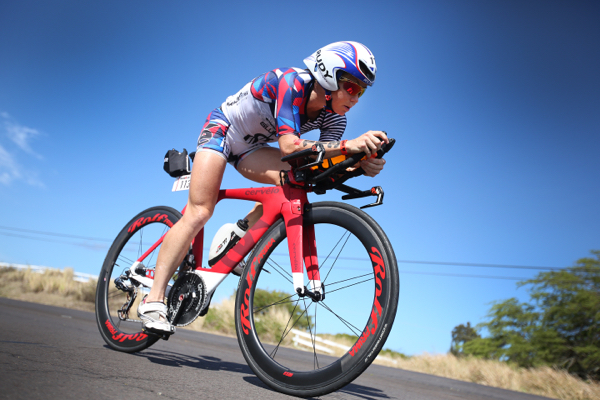
Dani_KonaAfter her dominating 2015 season it’s pretty obvious that Daniela Ryf has claimed the top spot in my rankings. Daniela was unbeaten all year, and won an unprecedented string of races including the European Championships in Frankfurt, the 70.3 World Championships in Zell am See, the Ironman World Championships in Kona and the $1 Million Dollar prize for the Triple Crown
(Photo: Dani on the bike in Kona. Credit: Jay Prasuhn)

Rachel Joyce had another solid season, improving from 3rd to 2nd in my rankings. Once again she was struggling with a mid-season injury but managed to get in excellent Kona shape. She finished second even after loosing time when the zipper of her racing top came undone at the start of the bike and she missed the front group. She’ll be working hard for a shot at winning in Kona next season.

Mirinda Carfrae dropped to third place after a relatively slow (for her standard) validation race in Melbourne and an unfortunate DNF in Kona. I expect her to be back in great shape for 2016 – and hungry to prove that she can still challenge Daniela.

Caroline Steffen (#4) hasn’t had a good 2015 season. She’s had solid results with podium finishes in Melbourne and Frankfurt and a couple of wins in 70.3s, but she was sick too often to train and race well. She is still a good enough athlete to finish 9th in Kona even with food poisoning in the days before. She’ll be looking to step it up again in 2016.

Adopting a similar season plan to her IM debut season in 2013, Liz Blatchford (#5) had much better results than in 2014 and ended her season with a podium finish in Kona. Next year will be interesting for her: Can she solidify her position as one of the best long distance athletes and a Kona podium finisher or will she struggle to confirm the results of her 2013 and 2015 season?

Eva Wutti (#6) had a year with some ups (winning her home IM in Austria with another sub-9 time) and downs (struggling with an injury and having to cancel 70.3 World Champs in her home country). She was disappointed with her 16th place finish in Kona, but I consider that a solid first Kona race considering she was hardly able to run in the weeks before the race.

Susie Cheetham (#7) is the only new athlete in the female Top 10. She was steadily improving in her Ironman races, including a 6th place in Kona. It was only during this season that she became a full-time athlete so she seems to be in a great position to continue improving. With her run strength she’ll be a strong contender in her 2016 races.

Even though she had a disappointing DNF in Kona, Julia Gajer (#8) can be content with her 2015 season. A second place at IM Frankfurt showed that she is able to compete in the strongest Ironman fields. Ultimately her goal is to perform well in Kona, and she’ll be working towards the necessary improvements in the coming months.

Yvonne Van Vlerken (#9) decided not to race in Kona this year and declined her slot. Nonetheless she was racing a lot in the second half of the year, becoming the first athlete to have ten sub-9 finishes and already taking care of Kona qualifying even though she wasn’t in top form. She seems to plan for a much lighter racing schedule in 2016, with a clear focus on Roth and Kona. A healthy and rested Yvonne will be a strong contender for a Kona podium finish.

After some changes in her environment, Mary Beth Ellis (#10) had a couple of good results (wins at the ITU World Championship and at IM Mont Tremblant) but she still had issues to run well towards the end of the marathon that cost her the win at IM Switzerland (she finished 2nd) and a better place than 13th in Kona. In order to place well in Kona, she and her coach Brett Sutton need to figure out how she can run once more under 3:10 as she was able in her best IM years between 2011 and 2013.

Jodie Swallow (now #15) dropped out of the Top 10 – she had a great result in South Africa at the start of the year but was struggling to stay healthy. In Kona she tried to go for the win and had to pay the price with a DNF. Knowing her, she’ll be back in 2016 with aggressive goals.

Top 10 Men

Rank Name Nation Rating Last Race # Races
1 Jan Frodeno GER 08:07:22 IM Hawaii on 2015-10-10 4
2 Sebastian Kienle GER 08:14:23 IM Hawaii on 2015-10-10 11
3 Brent McMahon CAN 08:16:31 IM Arizona on 2015-11-15 4
4 Andreas Raelert GER 08:17:54 IM Hawaii on 2015-10-10 15
5 Frederik Van Lierde BEL 08:20:27 IM Hawaii on 2015-10-10 17
6 Nils Frommhold GER 08:20:39 IM Hawaii on 2015-10-10 7
7 Andy Potts USA 08:22:40 IM Hawaii on 2015-10-10 13
8 Timo Bracht GER 08:22:49 IM Mallorca on 2015-09-26 25
9 Eneko Llanos ESP 08:23:08 IM Hawaii on 2015-10-10 23
10 Marino Vanhoenacker BEL 08:24:38 IM Hawaii on 2015-10-10 20

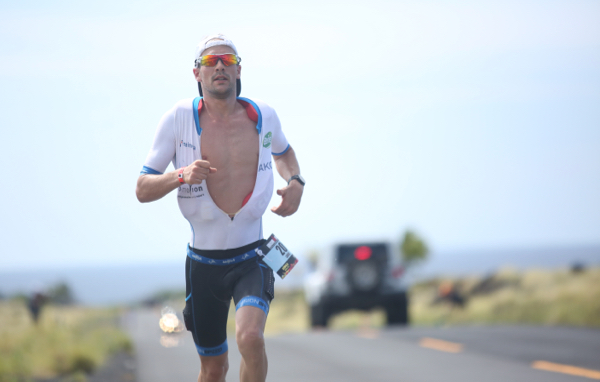
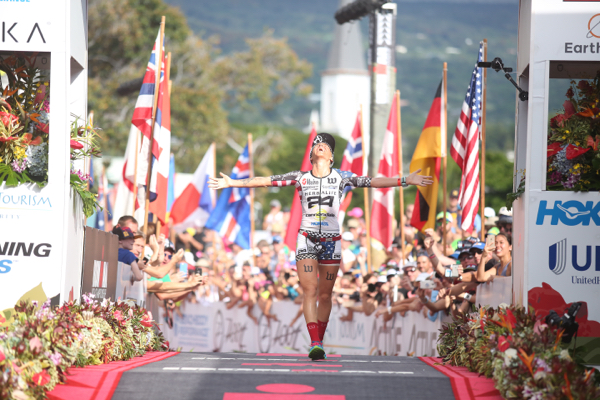
Jan_Kona

Similar to last year, there were quite a few changes in the Top 10 Ratings. Jan Frodeno is the clear #1 after a dream 2015 season including wins in Frankfurt, at the 70.3 Championships and in Kona. After he wasn’t ranked last year (he only had two finishes at the end of 2014), the question most often asked is how long he’ll be able to dominate. We haven’t seen a successful male title defense in Kona since 2009 (Craig Alexander) – and Frodo seems to be poised to be the next one.
(Photo: Jan being watched on the run in Kona, Credit: Jay Prasuhn)

Sebastian Kienle dropped back to second place. While he is probably disappointed with his season (especially his race in Kona) and being overshadowed by Frodo, he still had great results and is far from being finished. He’ll be hungry to step up again in 2016.

With Brent McMahon in #3 there is another previously unranked athlete in the Top 10. His 2014 and 2015 results (including a win in Arizona, a 3rd in Brasil and a 9th place in Kona) lead to his designation of “Rookie of the Year”, and he’s probably going to be even stronger in 2016.

Andreas Raelert in #4, Andy Potts in #7 and Marino Vanhoenacker in #10 are athletes that have improved their rating in 2015 and moved back into the Top 10. After a few disappointments in the last years and his DNF in Texas Andreas seemed to be at the end of his career, but he bounced back with a hard earned 6th in Frankfurt and a great second place in Kona, earning “Comeback of the Year”. Andy Potts won his summer IM in Coeur d’Alene and had another good race in Kona finishing fourth, but he’s probably a bit disappointed to once again miss a podium finish by one spot. He’ll turn 40 in 2016, so he won’t have too many season to gain at least one more spot. Marino had two sub-8 finishes when he won IM Brasil and IM Austria with the fastest 2015 Ironman. His only disappointment was a flat day in Kona that lead to a DNF. He’ll try to become the first athlete with IM wins on all continents by winning IM New Zealand in March.

Frederik Van Lierde (#5) and Nils Frommhold (#6) dropped a bit in the rankings. They’ve had a mixed season with some great results (wins in South Africa for Frederik and in Roth for Nils) but disappointing Kona races finishing in 25th and 29th place. I expect them to finish much better in Kona 2016.

Timo Bracht (#8) decided once again to skip Kona. He took some time to recover from his races at the end of 2014, was back in great shape for Roth (but finished second behind a superb Nils Frommhold) and won IM Mallorca at the end of his 2015 season. It seems that he wants to race Kona again in 2016, it’s going to be interesting to see how he’ll be doing (his most recent Kona finish was a 9th place in 2013).

Eneko Llanos (#9) had a solid 2015 season that included a 5th in South Africa, an 8th at IM Germany and a 7th in Kona. He’ll be another well-ranked athlete that is going to turn 40 in 2016, and I’m sure he’ll be looking for at least one more great result.

Last year we’ve also had a couple of other athletes in the top 10:

  • Dirk Bockel (was #4) was injured for most of the year, he’ll be looking for a comeback in 2016.
  • Craig Alexander (was #6) has continued to race 70.3s in 2015, but he ended his Ironman career after Kona 2014.
  • Clemente Alonso-McKernan (was joint #8) had a great end to his 2014 season with three podium finishes in three IMs within eight weeks and needed some extra time to properly recover from those races and also deal with an injury. He DNF’d in Kona and hasn’t finished a 2015 Ironman.
  • Bart Aernouts (was joint #8, now #17) had some great 70.3 results including a 4th in the 70.3 World Championships, but DNF’d in Kona.
  • Jordan Rapp (was #10, now #15) had ups (a win at IM Mont Tremblant) and downs (DNF in Texas, 21st in Kona after dealing with a broken saddle). Even so he seems to be in a good position to re-enter the Top 10 in 2016.

2016 Kona Pro Qualifying in Five Charts

While 2016 Kona Pro Qualifying takes a bit of a breather after the fall races, I wanted to discuss a few charts and observations about this qualifying cycle. The KPR rules itself haven’t changed, but there are some subtle issues that will impact how the season develops.

Ironman Races Qualifying for Kona 2016

Here is an overview of the Ironman races that offer qualifying points for the first cutoff at the end of July for Kona 2016. To be exact, the first of these races was IM Vichy on August 30th, the last ones will be IM Switzerland, IM Lake Placid (WPRO only) and IM Whistler (MPRO only) on July 24th.

The following table shows for each of the continents and months when IM races with a Pro category will be (the numbers correspond to the day of the race):

IMRaces

The only Ironman not shown here is IM Hawaii, which is an 8000 points race in October, but as a World Championship it doesn’t really “belong” to one continent. In addition, there will be some more Ironman races in August, but these haven’t been finalized yet and are not included in any further graphs.

KPR Points in IMs Per Continent From 2014 to 2016

The following chart shows how the total number of KPR points per continent has changed over the last few years (again excluding the August races but showing “Kona” as a separate category):

KPRYears

Some observations about the developments:

  • The number of North American IMs has been shrinking (Wisconsin and Florida no longer a Pro race in 2016, and Coeur d’Alene moves to August probably without a Pro category).
  • Growth in Europe continues (IM Vichy as an additional race in the 2016 season), overtaking North America as the continent with the most IM races and KPR points.
  • There have been declines in Asia (IM Taiwan moving to October, Pro category not clear; also cancellation of IM Japan in August), Australia (cancellation of IM Melbourne) and South America (Fortaleza without a Pro race in 2016 season)

Some of these changes are short term changes that will probably be reversed in the following years, for example Ironman has expressed their interest in expanding in the Asian market. But I expect the trend of fewer Pro races to continue, and probably be extended from North America to other continents. The way I see it, this is a likely change for the expected 2017 redesign of the KPR.

Breakdown Of 2016 Points By Continent

The reduced number of IM Pro races has been most pronounced in North America. The following chart shows the distribution of the 2016 KPR points (excluding Kona) available in the different continents:

KPRPoints

This corresponds quite well to the number of races: Europe has 10 of 22 non-Kona races (45%), while North America only has 5 (23%).

Breakdown Of 2016 Prize Money By Continent

There is less of a disadvantage for North America when considering the Prize Purse:

KPRPrizePurse

Most of the North American IMs are races with a 100k$ prize purse, while a lot of the European races only offer 25k$ for the field.

Breakdown of 2015 Pro Finishers Per Continent

To build an opinion if Ironman’s distribution of races is detrimental to North American Pros, one has to consider where the Pros are from. The next chart breaks down the number of Ironman finishers in 2015 season Pro races based on athlete’s nationality and corresponding continent:

ProFinishers

(I could have included a similar chart showing the number of Pros qualified for Kona per continent, but the distribution is almost identical and wouldn’t have provided additional information.)

Comparing the points distribution to the distribution of the athletes:

  • Europe has the most Pros and also the largest number of points. Still there are only 41% of the points for 52% of the Pros.
  • There is also a gap for North America, but the difference is smaller (22% of points for 28% of the Pros).
  • Australia has more points than their share of Pros would indicate (19% of the points vs. 13% of the Pros).
  • The continents with fewer Pros have a larger share of points, especially South America and Africa who only have between 1% and 3% of the Pros but 4% to 7% of the points.

Summary

Comparing the continents based on the nationality of athletes may not be completely fair to North America, as there are a lot of non-US athletes that have moved to the US or at least spend a considerable time there. But the number of IMs in North America is still roughly fitting as North America has a larger share of the prize money and also a larger number of 70.3s (in the 2015 season, there have been 17 in Europe and 25 in North America) which should help both the established Pros and the athletes still growing in the Pro ranks. However, qualifying for Kona as a Pro is more and more a year-round and global endeavor, one that needs careful planning and almost flawless execution.

If you are interested in Pro qualifying, you should subscribe to the 2016 KPR Observer newsletter!
More details can be found here.

Kona 2015: Not the Race Shiao-Yu Li Was Looking For

Looking through the Kona splits of the Pros, one odd result caught my eye: Shiao-Yu Li, the first Taiwanese athlete to qualify for Kona as a Pro, has splits up to 25.3 miles of the run, but no finish. I was intrigued: Was there a last minute meltdown in the finish chute? I started to ask around and found that I was not the only one who wondered what was going on. Fellow Pro Ruth Brennan-Morrey remarked:

I’m curious: I came out of the water with Shiao-Yu Li. She left T1 first, then she was 15 minutes up from me at mile 11.4! In the end, my bike split is 5 minutes faster than hers, so I should have passed her. I never saw her.

7th place finisher Sarah Piampiano said:

I’ve had a slow 1:10 swim, but I thought I’d still be faster than Shiao-Yu. I was a bit surprised when I overtook her on the Queen K, but focused on my race.

Taking a Wrong Turn

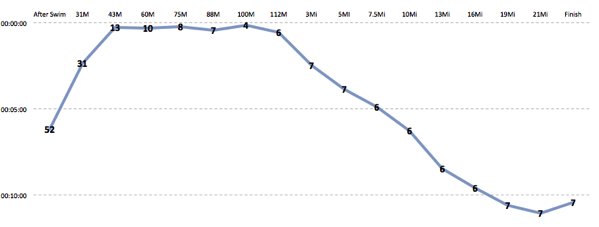
Shiao-Yu’s splits also offer an explanation of what likely happened: After T1 she wasn’t registered before 11.4 miles on the bike, she didn’t have any splits at the 5 mile and 7.8 mile marks. All of a sudden she had a big gap to Ruth, and while she swam about 20 minutes slower than Daniela Ryf, she was only 9 minutes behind at the 11.4 mile bike split. 

ShiaoYuBikeKona
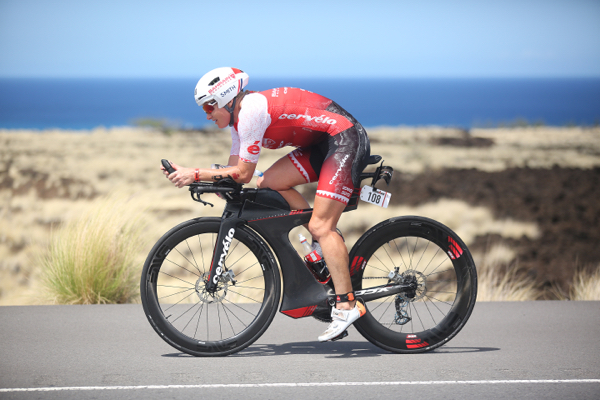
Shiao-Yu Li on the bike in Kona 2015 (Credit: Herbert Krabel, Slowtwitch, used with permission)

It’s pretty obvious that Shiao-Yu must have cut some part of the early course. Her friend and manager Trisha Chen relates what happened: 

Shiao-Yu is a person with very very poor sense of direction. After jumping on her bike and starting to chase others, she unfortunately missed the first 8 K of bike course. The accident happened because when she was about to turn to the right following a volunteer’s direction, another volunteer told her to go to the left.

We all knew that recognizing the course is athlete’s responsibility, however, sometimes the race has been very tense and mistakes might be made by both volunteers and athlete.

Her description is not 100% clear, maybe Shiao-Yu Li turned left coming up Makala Blvd out onto the Queen K instead of starting the loop through town. Another possibility is that she made a U-turn on the Queen K instead of turning right onto Palani Road and then down to the “Hot Corner”, cutting a major part of the loop through town that normally ends with a U-turn at the end of Kuakini Highway. Kona seems to be a pretty simple course to follow, especially considering that Shiao-Yi raced Kona before as an agegrouper. But an inadvertent wrong turn during the race seems much more plausible to me than an intentional course cutting since that is very easy to detect in Kona. Shiao-Yu must must have been confused about the directions and probably just went the wrong way.

Trisha continues:

Pretty soon she thought she might have been mislead and missed some kilometers in town because some stronger swimmers came up behind her. She immediately called upon one referee who was at around 10-20K on bike course and told him she thought she might have missed the previous course. The referee asked her whether she was sure about it or not. And he told her that since no one reported this and he did not know what to do and since she did not get a penalty back then, she should keep going. She even went to the penalty tent to ask if she could redeem the missing course by adding extra time. But since she did not receive any punishment from any referee, she could not do anything but keep going.

Shiao-Yu felt very very uncomfortable during the whole 180K. She wants to compete in honor and honesty!!

It’s probably during the discussion in one of the penalty tents that Shiao-Yu was overtaken by Ruth. The discussion must have cost a fair bit of time as well: In the end, her 2015 bike time (about 5:40 if you add 15 minutes for the 8k she missed) was slower than her 2012 time of 5:29:31 when she participated as an age grouper.

Still Finishing After All

Back in T2, Shiao-Yu tried again to correct her mistake:

After retuning to T2, she spent almost 20 minutes to find different referees, confessed to them that she was missing the course. However, since no referee or no one accused her upon his matter, it is only Shiao-Yu’s confession and honesty to be the evidence.

We are hoping that there is another way to redeem such mistakes (adding extra times…) so that athletes can still have a second chance to finish the race. After all, athlete all fought hard to get to Kona.

But the rules for not following the course are very clear for Ironman races: 

Section 2.01 GENERAL BEHAVIOR

Each athlete must:

(k)  Follow the prescribed course. It is the athlete’s responsibility to know the course. Athletes must cover the prescribed course in its entirety. Failure to do so will result in a disqualification.

Basically, the rulebook does not offer any way for her to correct the mistake she made, even if it allows for her to continue the race:

Section 3.03 DISQUALIFICATION

(a) […] If disqualified, an athlete may finish the Race unless otherwise instructed by a Race Referee.

(c) […] Neither timing splits nor Race results will be listed for disqualified athletes.

Her result would still be a DQ, but she wanted to continue:

But Shiao-yu never quit a single triathlon race before in the past 13 years, even when she was hurt in races. In her mind, no matter what happened, she would do her best and manage to run to the finish line. So she expressed her strong desire to finish this race anyway. 

After Shiao-Yu continued the race, she ran quite well and you could see her cross the line in the live coverage. Some results show her completing the run in 3:24, for now the “official” Athlete Tracker on Ironman.com lists her as a DNF. Even though she is disappointed with this year’s race, she looks forward to the next season:

Shiao-Yu felt comfortable about her strength and power and she believed that she still has great room to be improved. She has been much motivated to prepare to go back to Kona again.

While Shiao-Yu is struggling to swim well after being hit by a motorcycle while in high school, she has been steadily improving on the run. She probably needs some off-time after Kona. In order to get enough points to qualify, she had to race five Ironman races this season: Malaysia (4th), Taiwan (4th), Lanzarote (4th), UK (5th) and Japan (1st) – all before racing Kona 2015! If she manages to step up to finish more often on the podium, she has a good chance to qualify again for Kona. Hopefully she’ll have a better race then!

A big thank you to everyone who helped with this article, especially Trisha Chen for sharing Shiao-Yu’s perspective (and Caroline Livesey for putting her in touch with me) and Herbert Krabel (Slowtwitch) for permission to use the photo.

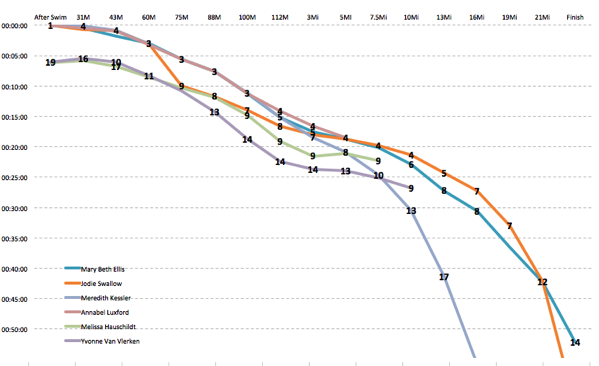
Kona 2015: Preliminary Bike Analysis (Women)

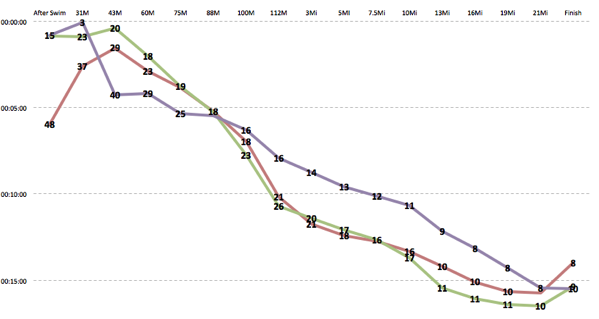
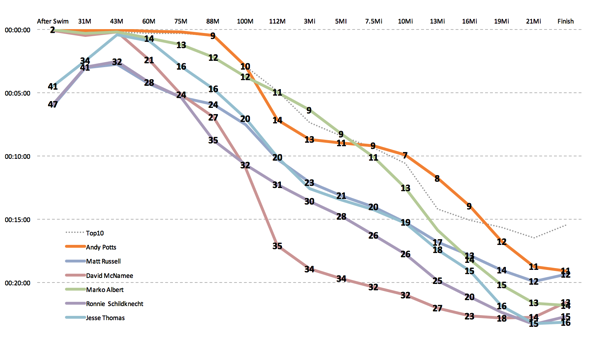
With the Top 16 of the women in, here are a few observations about the women’s bike leg:

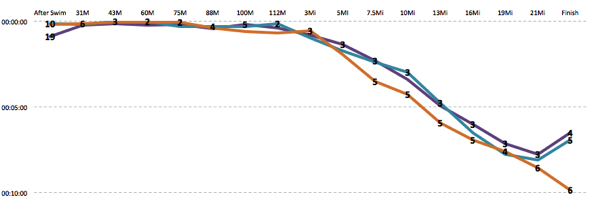
  • The bike for the women has been very fast, most of the women raced considerable faster than their expected time.
  • Best relative performances have been by Mareen Hufe (6:45 faster) and Michelle Vesterby (7:18 faster).
  • Only Carolin Steffen has been considerably slower than what I would have expected based on her previous times (11 minutes slower). Susie Cheetham was slower by four minutes, but is still in a good position for a Top 10 finish.

Top 10 Projection

Here are the current projections for Top 10 on the female side (with Angela Naeth a DNF):

  1. Daniela Ryf SUI 09:02:12
  2. Rachel Joyce GBR 09:10:21
  3. Jodie Swallow GBR 09:13:37
  4. Liz Blatchford AUS 09:19:07
  5. Mary Beth Ellis USA 09:20:08
  6. Camilla Pedersen DEN 09:20:51
  7. Michelle Vesterby DEN 09:20:53
  8. Lucy Gossage GBR 09:23:35
  9. Caroline Steffen SUI 09:24:06
  10. Susie Cheetham GBR 09:27:34

Bike Analysis

Rank  Name Nation Bike Bike Diff
1 Daniela Ryf  SUI 04:50:46  -04:37 
2 Angela Naeth  CAN 04:54:54  -04:10 
3 Jodie Swallow  GBR 04:58:48  -04:05 
4 Mareen Hufe  GER 04:59:15  -06:45 
5 Camilla Pedersen  DEN 04:59:17  -05:55 
6 Mary Beth Ellis  USA 04:59:29  -04:43 
7 Michelle Vesterby  DEN 05:00:41  -07:18 
8 Rachel Joyce GBR 05:01:29 -01:32
9 Lucy Gossage  GBR 05:02:40  -04:07 
10 Annabel Luxford AUS 05:04:00 02:46
11 Heather Jackson USA 05:04:43 01:03
12 Liz Blatchford  AUS 05:07:25  -03:39 
13 Caroline Steffen  SUI 05:10:53  11:01 
14 Dede Griesbauer  USA 05:11:08  -05:53 
15 Susie Cheetham  GBR 05:14:33  04:42 
16 Elizabeth Lyles USA 05:18:32 02:22
Select your currency
EUR Euro
USD United States (US) dollar

By continuing to use the site, you agree to the use of cookies. more information

The cookie settings on this website are set to "allow cookies" to give you the best browsing experience possible. If you continue to use this website without changing your cookie settings or you click "Accept" below then you are consenting to this.

Close